The 1930s throughout the 1930s
The Bias Cut
Cutting garment pieces at 45 degrees to the fabric's grain so they stretch, drape, and cling - the construction technique behind the decade's most famous gowns, and one of the hardest to master.
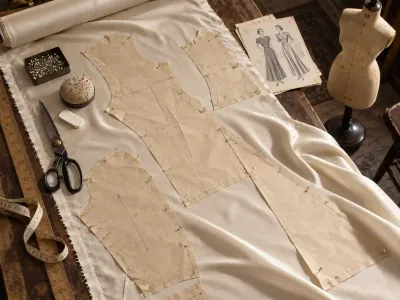
Woven fabric has two straight grains: the lengthwise grain, running parallel to the selvedge, and the crosswise grain, running from selvedge to selvedge. Along either of those, woven fabric barely stretches. But cut it at 45 degrees - on the true bias - and it behaves completely differently. It stretches, it drapes into soft folds, and it moulds itself to whatever it's lying over. The bias cut uses that property to make whole garments that follow the body without darts, boning, or much fitting at all. It's the construction secret behind the bias-cut evening silhouette.
Madeleine Vionnet is the designer who mastered it, but by the 1930s the technique was everywhere, from couture gowns to mass-market dresses and slips. A bias-cut dress might have its skirt panels cut on the bias for swing and cling, or be cut entirely on the bias, with seams spiralling around the body. Designers used it for cowl necklines that fall into perfect folds, for skirts that flare at the hem while hugging the hips, and for backless gowns that have to stay in place with minimal support.
As someone who sews, I have enormous respect for 1930s bias work, because it's genuinely difficult. Bias-cut pieces stretch as you handle them, so seams can easily end up wavy or longer than intended. Pairs of pieces need to be cut carefully so the grain matches on both sides, or the garment will twist on the body. Hems drop unevenly as the fabric relaxes, so a bias-cut dress has to hang for a day or two before the hem is levelled. And it takes a lot of fabric, because the pattern pieces sit diagonally across the width. That's why cheaper 1930s dresses often use bias only in certain panels - and why a fully bias-cut gown was a real sign of skill and expense.