The 1930s throughout the 1930s
Godets and the Flared Hem
Triangular fabric inserts and shaped panels set into skirts to keep them slim over the hips but flaring at the hem - the everyday construction trick behind the decade's graceful line.
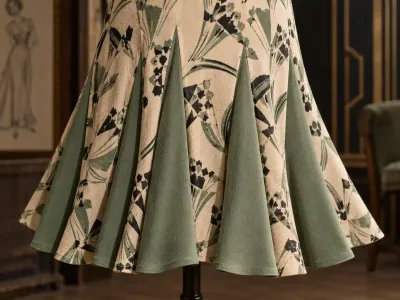
The ideal 1930s skirt was slim and smooth over the hips, then flared out gracefully toward a mid-calf or longer hem, swinging as the wearer walked. The bias cut was one way to achieve that, but it was expensive, used a lot of fabric, and was difficult to sew. For everyday dresses, especially ones made at home or by manufacturers on a budget, the more common solution was the godet.
A godet is a triangular or fan-shaped piece of fabric set into a seam or a slash in the skirt, with its point toward the waist and its widest part at the hem. The skirt stays close-fitting above the godet, then opens out below it into extra fullness exactly where it's wanted. 1930s dresses use godets in all sorts of ways: at the side seams, in the centre front and back, in pairs, or in sets all around the skirt. They're often combined with gored skirts - skirts made from several shaped panels that narrow at the waist and widen at the hem - and with seamed yokes at the hip. Designers also loved decorative versions, with godets cut from contrasting fabric, set in with pointed or scalloped tops, or finished with pleats.
What I love about godets is how clever they are. They give the look of a much more expensive, bias-cut skirt using fabric cut on the straight grain, which is easier to handle and more economical. Setting in a godet neatly takes skill, especially getting a sharp, flat point at the top, but it's a very achievable technique for a home dressmaker, and 1930s pattern companies used them constantly. If you look at a 1930s house dress and wonder how it gets that lovely swing at the hem, the answer is usually a godet or two.