The 1930s throughout the 1930s
The Depression House Dress
A cheap, washable, printed cotton day dress with short or puffed sleeves and a mid-calf hem - the garment most women actually wore through the Depression, far from Hollywood satin.
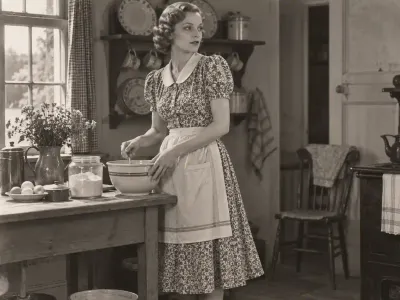
Hollywood's bias-cut satin gets most of the attention, but the garment that really defines how ordinary women dressed in the 1930s is the humble house dress. It's a simple day dress, usually in printed cotton, with a fitted bodice, a natural waist, short or puffed sleeves, a collar or tie at the neck, and a skirt falling to mid-calf. It was worn for housework, errands, and visiting - pretty much all day, every day.
What made it so important was cost and practicality. During the Great Depression, a lot of families had very little money for clothes, and a cotton house dress was cheap to buy, easy to wash, and hard-wearing. Ready-made versions were sold in huge numbers through department stores and mail-order catalogues - Kansas City's Nelly Don company built a large business on attractive, affordable house dresses - but many were home-sewn, from cheap commercial patterns or from flour and feed sacks printed with dress-fabric designs, a practice that carried right through into the 1940s.
I love these dresses because they show how much design went into everyday clothes, even with very little money. The prints were cheerful - small florals, checks, polka dots, and geometric patterns - and the details were thoughtful: contrast collars and cuffs, rows of buttons, bias-bound edges, and pockets. The skirts often borrowed the decade's godet and panel construction for a graceful flare at the hem. It's the same natural-waisted silhouette you'd see on a Paris runway, just translated into washable cotton for a kitchen in Kansas.