The 1930s turn of the decade (1929-1932)
The Return of the Natural Waist
The abrupt end of the 1920s flapper line - waists climbing back to their natural position and hemlines dropping to mid-calf almost overnight, just as the stock market crashed.
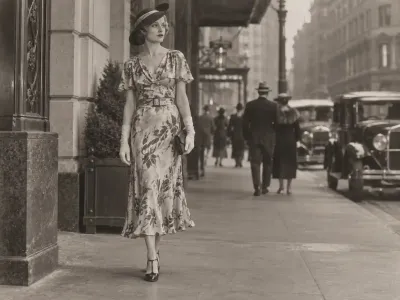
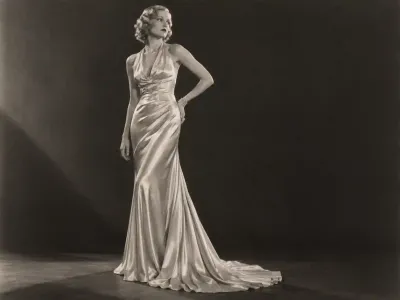
Start the 1930s here, because the decade opens with one of the fastest silhouette reversals in modern fashion. Through most of the 1920s the fashionable line was straight, loose and dropped - a low waist sitting around the hips and a hemline that, by 1927, had climbed to just below the knee. Then, over roughly two seasons around 1929-30, both of those things flipped. The waist climbed back to where the body's actual waist is, and hemlines fell towards mid-calf for day and all the way to the floor for evening.
The designer usually credited is Jean Patou, and Vogue's editor Edna Woolman Chase told the story well. One evening in 1929, she recalled, Patou stared across a room at women in short dresses by Chanel, then rushed to his workroom and started making frocks that swept the ground, with natural waistlines. The detail is more useful than the legend. His sports clothes were worn four inches below the knee, wool day dresses a little longer, afternoon dresses longer still, and his evening gowns touched the floor on three sides and just skimmed the feet at the front. The V&A has a Patou evening dress that was photographed for the Paris archives on 12 February 1930: pink silk crêpe, a slightly pouched waist, and an ankle-length skirt draped across the hip and hung with long silk fringe. Still, it spread through every Paris house so quickly that it's better understood as a collective mood than one man's invention, and Patou himself had been heading that way since winter 1928, with fuller skirts, an impression of length, and a draped bodice that lifted the waistline.
It also happened to land just as the Wall Street crash of October 1929 was tipping the world into the Great Depression, which has led to a lot of tidy theories about hemlines falling with the markets. I'm sceptical of those. Designers had begun lowering hems in 1928, and as the historian Pamela Parmal points out, on 27 October 1929, three days after Black Thursday, the New York Times was already reporting women who called the push for long skirts "an insidious attempt to lure women back into slavery." Others were simply practical, and refused to throw out wardrobes whose hems couldn't be let down. Textile manufacturers were delighted, since an inch of extra length meant millions more yards of cloth sold. It's fair to say, though, that the new silhouette suited the more sober mood that followed.
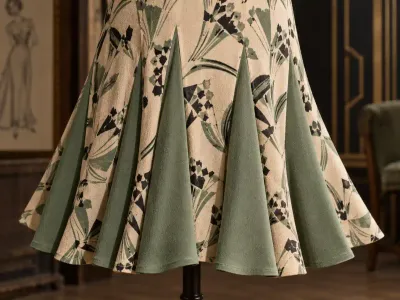
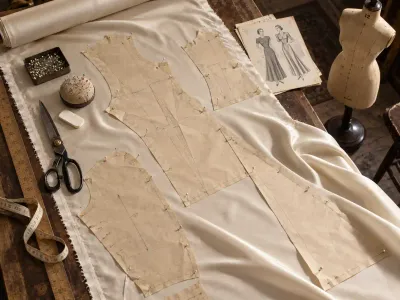
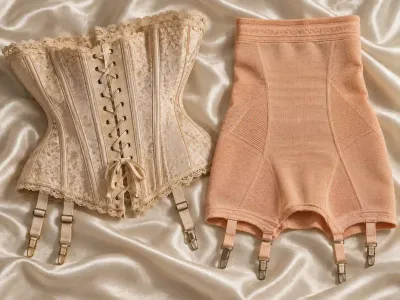
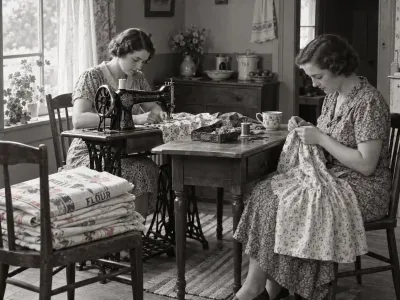
What I think is most interesting is how the new shape was made. Rather than going back to boned, cinched waists, 1930s clothes defined the waist softly, with seaming, belts, a lighter elastic girdle underneath, and above all cut. A summer day dress sold by the Paris department store La Samaritaine in 1929, now in the V&A, has the whole recipe in one garment. It's printed silk georgette, slightly gathered at the natural waist on an elastic band, with a finely pleated yoke across the hips and a skirt of bias-cut gores that stays close over the hips and thighs and flares out towards the knee. Even the print is placed to help: its bands of flowers run diagonally on the bodice and yoke and horizontally on the skirt. Home dressmakers got the same idea in pattern form. Butterick 2964, also from 1929, is a slip-over frock with a two-piece flared skirt that could be cut either on the bias or on the straight grain.
You can see that logic in everything from the everyday house dress to the most expensive bias-cut evening gown, and in the godets set into countless skirts to put the flare exactly where it was wanted. The flapper's boyish straight line was gone, and in its place was something longer, more grown-up, and far more interested in the shape of an actual body.
Sources
- Amy de la Haye, "Patou, Jean", Encyclopedia of Clothing and Fashion - Encyclopedia.com
- Pamela A. Parmal, "Hemlines", Encyclopedia of Clothing and Fashion - Encyclopedia.com
- Evening dress, pink silk crêpe, Jean Patou, 1930 - V&A Collections
- Day dress, printed silk georgette, retailed by La Samaritaine, Paris, 1929 - V&A Collections
- Butterick 2964, Slip-over frock with two-piece bias or straight flared skirt, 1929 - Commercial Pattern Archive, University of Rhode Island