The 1930s throughout the 1930s
The Trouser Silhouette
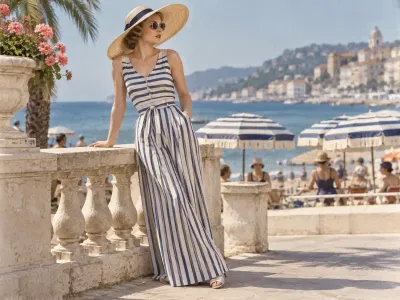
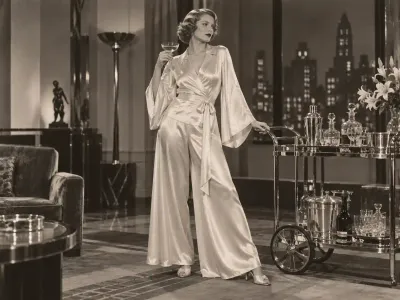
Wide-legged, high-waisted trousers worn off the beach for the first time - made glamorous by Marlene Dietrich and Katharine Hepburn, and still daring for most women by the end of the decade.
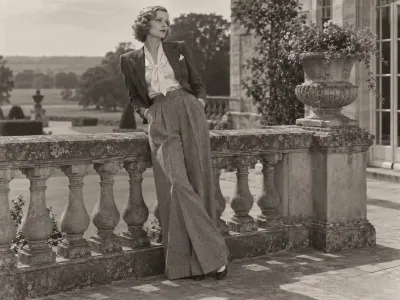
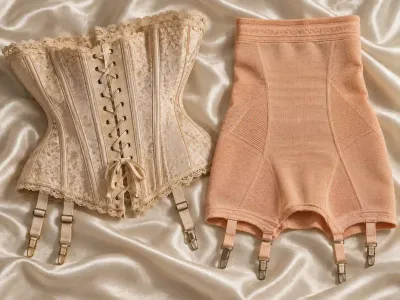
Women had worn trousers before the 1930s - for sport, for war work, and in the loose, flowing beach pyjamas that became fashionable on the Riviera at the turn of the decade. What changed in the 1930s is that trousers began to appear, occasionally and controversially, as chic clothes in their own right. In numbers the shift was small. The dress historian Jane Farrell-Beck describes fashionable wardrobes taking in trousers "primarily for active sports, gardening, and strictly informal social events" - but even that was enough for the foundation trade to invent a new garment for them, the pantie girdle, from about 1934.
The shape was wide and fluid: a high waist, often with pleats at the front, and a full leg falling straight from the hip to a long, pressed hem. Cut in wool flannel or crêpe and worn with a silk blouse, a knit or a tailored jacket, it had a long line that suited the decade's taste for height. The V&A has a beautiful example from the sporty end of things, a beach trouser suit bought from Arnson of Clifford Street, London, in 1936-37 for £30 and worn by Vera, later Lady Swettenham. It is white wool and linen with a narrow red and blue stripe: a fitted jacket, a twisted red, white and blue wool belt, and long, wide-legged trousers with turn-ups of about three inches and a zip at the side - a side opening, not a front fly, which is exactly how a dressmaker would expect women's trousers of the period to close.
Home dressmakers could follow along cheaply. Simplicity 2009, from 1936, is a pattern for "Misses' Slacks, Halter & Bolero" that cost 15 cents, in a size 16 for a 34-inch bust and 37-inch hip. The slacks are cut from a back, a side front and a front, and they come paired with a halter top and a little bolero, which tells you exactly where they were meant to be worn: on holiday, not on Main Street.
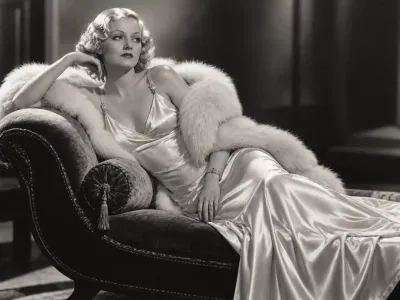
Hollywood did most of the work of making trousers glamorous. Marlene Dietrich wore a tuxedo and top hat by Travis Banton in Morocco (1930), the film that made her a star, and afterwards her habit of wearing men's trousers off screen became famous in its own right. The National Portrait Gallery in Washington tells the best story about it: in 1933, sailing to France on the liner Europa, she caused a stir by wearing a white trouser suit on deck, and the head of the Paris police reportedly warned that she would be arrested if she wore such clothing in the city. She stepped off the train in her most mannish tweed suit, was not arrested, and - so the story goes - received an apology and a sandalwood bracelet from the police chief. She also bought from Elsa Schiaparelli's Paris and London salons, and Schiaparelli had made trousers one of her signatures, wearing wide-legged culottes herself on a work trip to London in 1931. Katharine Hepburn made slacks part of her off-screen image from her first days in Hollywood, and her biographer William J. Mann points out that in the early 1930s they were considered subversive rather than charming.
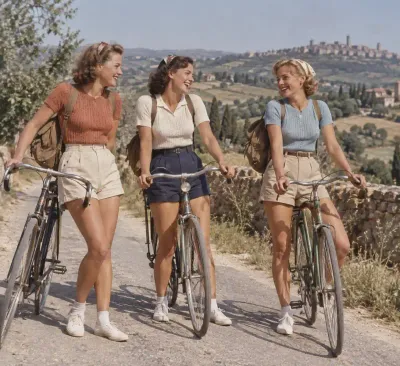
It's important not to overstate any of this. For most women in the 1930s, trousers were still for the beach, the garden, sport or the countryside, and wearing them in town could get you stared at. But the image of a stylish woman in wide-legged trousers was firmly established by the end of the decade, which made it much easier for women to take them up when war work demanded it - as the 1940s slacks silhouette shows. The 1930s is where trousers first become fashionable. The 1940s is where they become normal.
Sources
- Marlene Dietrich: Dressed for the Image - National Portrait Gallery, Smithsonian Institution
- Morocco (film notes) - Berkeley Art Museum and Pacific Film Archive
- William J. Mann, Kate: The Woman Who Was Hepburn (2006), sample chapter - Library of Congress
- Schiaparelli: Fashion Becomes Art, large print guide - V&A
- Beach trouser suit, Arnson, London, 1936-1937 - V&A Collections
- Simplicity 2009, Misses' slacks, halter & bolero, 1936 - Commercial Pattern Archive, University of Rhode Island
- Jane Farrell-Beck, "Girdle", Encyclopedia of Clothing and Fashion (2005) - Encyclopedia.com