The 1940s wartime (1941-1945)
The Slacks Silhouette
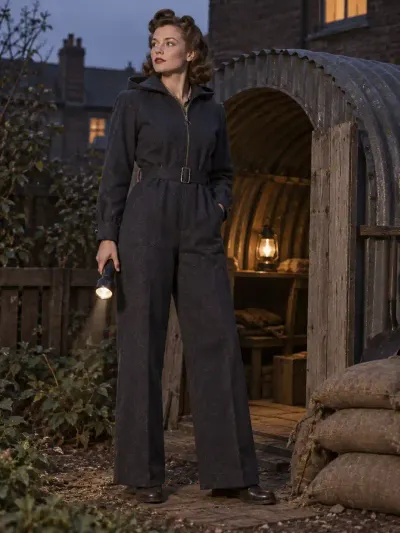
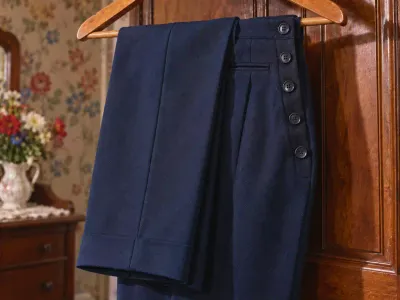
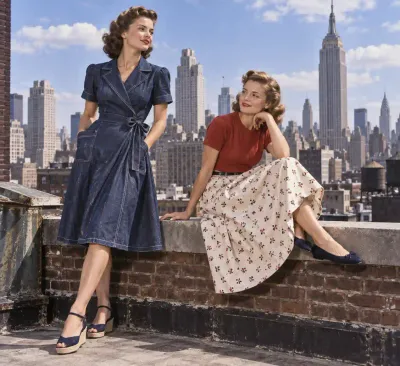
High-waisted, wide-legged trousers worn with a tucked-in blouse or sweater - the silhouette that moved women's trousers from Hollywood novelty to everyday working wardrobe.
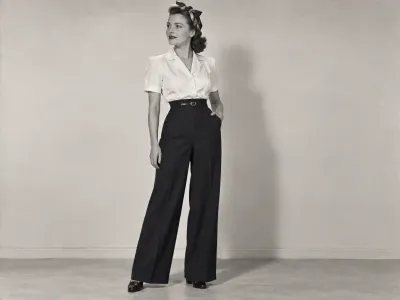
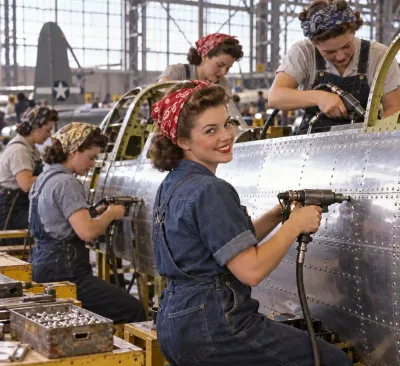
Women wearing trousers in the 1940s wasn't brand new. Marlene Dietrich and Katharine Hepburn had made them glamorous through the 1930s, and beach pyjamas and sporty slacks already existed for holidays. What the war changed was who wore them and why. Once women were on factory floors, in shipyards, on farms with the Land Army, steering canal boats and running down to the shelter at night in a siren suit, trousers stopped being a statement and became the obvious practical answer. That shift in reason is really the whole story of this silhouette.
It's easy to forget how big a step that was for ordinary women. Charity Adams, an officer candidate in the new Women's Army Auxiliary Corps in 1942 who later rose to lieutenant colonel, remembered buying everything on the list of suggested supplies for training camp "except the slacks and shorts. I had never owned either, feeling that I was not the type to wear them." The Army historian Judith Bellafaire sums it up bluntly: "In small town America in 1942, ladies did not wear slacks or shorts in public." Within a couple of years plenty of those same small-town women were wearing trousers to work every day, and some were wearing them in uniform.
The Imperial War Museums' photographs show how quickly they became normal in Britain. In a 1942 Ministry of Information series on the canal barge Heather Bell, carrying coal on the Birmingham Canal near Tipton, the woman at the tiller - Miss March - wears a woollen jersey and corduroy slacks in fine weather. Even the Home Guard issued women's battledress trousers: the IWM has the dark green serge battledress blouse that Auxiliary Leader L. Bridgeman of the 11th Denbighshire (Ministry of Food) Battalion wore on the VE Day parade at Colwyn Bay in May 1945, catalogued alongside her matching trousers.
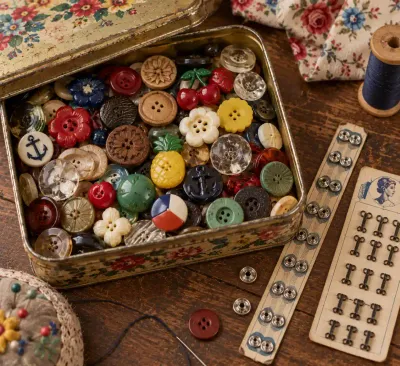
The civilian shape is distinctively of its decade: a very high waist, sitting at or a little above the natural waistline, a side opening closed with buttons or a short zip (the closures entry explains why that detail varied so much), and a full, straight leg falling from the hip to a pressed crease (in wool gabardine when it could be had). Because the opening sits at the side rather than the front, the front can be cut smooth, with a pleat or two falling from the waistband, and that's a good part of why the line looks so clean. Cut in gabardine, flannel or corduroy and worn with a tucked-in blouse or fitted knit and a turban or headscarf, it made a long, vertical line that's actually quite elegant, and it's still the reference point whenever wide, high-waisted trousers come back around.
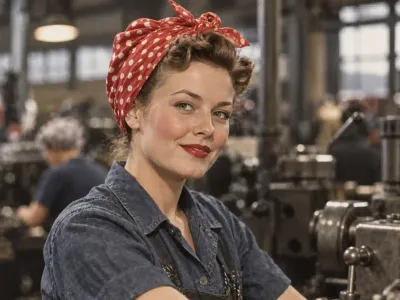
It wasn't a universal or uncontested shift, though. Hepburn's off-screen uniform of high-waisted slacks and a button-down shirt helped define what the Fashion Institute of Technology calls the emerging "American look," but FIT also notes that while some women wore trousers in the 1940s, especially for war work, it was still unusual to see a woman in them so visibly. A lot of women changed out of their slacks before going into town. Still, the war and the Rosie the Riveter moment gave trousers a respectability they'd never had for ordinary women, and it didn't fully reverse after 1945. The slim capri pants of the next decade had a different, resort-wear pedigree, but they arrived in a world that had already got used to women in trousers. It's the quiet long-term winner of the decade.
Sources
- Judith A. Bellafaire, The Women's Army Corps: A Commemoration of World War II Service, CMH Publication 72-15 (US Army Center of Military History) - HyperWar transcription
- "Women run a boat: life on board the canal barge 'Heather Bell', 1942" (D 7651) - Imperial War Museums
- Blouse, Battledress (women's): Auxiliary Leader L. Bridgeman, 11th Denbighshire (Ministry of Food) Battalion, Home Guard (UNI 5322) - Imperial War Museums
- Karina Reddy, "1940-1949" (decade overview) - Fashion History Timeline, Fashion Institute of Technology