The 1940s early-to-mid 1940s
The Zoot Suit and Pachuca Style
A deliberately excessive youth style born in Black and Latino communities, worn by young women as well as men, that ran straight into wartime fabric restrictions - and into the 1943 Zoot Suit Riots in Los Angeles.
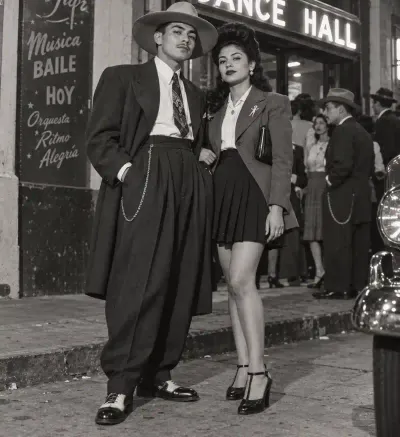
Most of the 1940s section is about women following the rules - rationing, restrictions, make do and mend. This entry is about a style that deliberately broke them. The zoot suit came out of Black jazz and dance culture in places like Harlem in the late 1930s, and was quickly taken up by young Mexican American, Filipino American, and other working-class youth, especially in Los Angeles. For men it meant a long, broad-shouldered drape jacket over high-waisted, very full trousers that tapered sharply at the ankle, often with a long watch chain and a wide-brimmed hat. It was loud and extravagant on purpose.
It's easy to forget that young women were part of this too. Mexican American women who embraced the style, often called pachucas, had their own look: high, voluminous pompadour hairstyles, dark lipstick, fitted sweaters or drape jackets, short skirts, and sometimes trousers of their own. For a lot of these young women, the style pushed back against two sets of expectations at once - the conservative expectations of their own families and communities, and the assumptions of a wider society that treated them as outsiders.
Then the war arrived, and the zoot suit's excess became a political problem. In 1942 the War Production Board limited the fabric in clothing - L-85 for women's wear, with parallel rules for menswear introduced that March - which made the zoot suit effectively illegal to manufacture and turned wearing one into a sign, to critics, of being unpatriotic. In June 1943, tensions in Los Angeles exploded into the Zoot Suit Riots, when crowds of servicemen went through the city attacking young Mexican American men - and some Black and Filipino youths - stripping them of their suits and beating them, while police largely looked on or arrested the victims. I think this belongs in a fashion history site precisely because it shows how much clothing can carry: a style of dress became a target for racial violence, and for many who wore it, the zoot suit was never just about fabric.