The 1940s wartime (1940-1945)
The Rise of American Fashion
With Paris cut off from 1940, American stores, editors, and designers had to stand on their own for the first time - and the result was the 'American Look,' Press Week, and the start of New York as a fashion capital.
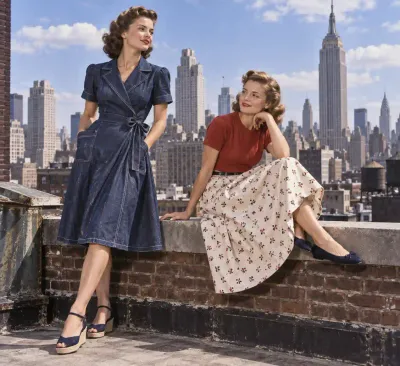
Before 1940, the American fashion industry worked on a simple model: buyers and editors went to Paris each season, and American manufacturers copied or licensed what they saw. American designers mostly worked anonymously for manufacturers or stores, and their names rarely appeared on labels. When Paris fell in June 1940, that model broke overnight. There were no new Paris collections to copy, and American fashion had to decide what it actually was.
The answer came quickly, thanks to a handful of people who'd been pushing for it for years. Dorothy Shaver of Lord & Taylor had already been promoting American designers by name since the 1930s, and she did more of it during the war. The publicist Eleanor Lambert organised the first "Press Week" in New York in 1943, bringing fashion journalists to see American collections in one place - the direct ancestor of New York Fashion Week - and she also helped launch the Coty American Fashion Critics' Awards. Magazines like Harper's Bazaar and Vogue began championing American designers too, and returning expatriates like Mainbocher, who had been a Paris couturier before moving back to New York in 1940, gave the scene extra prestige. Mainbocher even designed the uniform for the WAVES, the US Navy's women's reserve.
What came out of this wasn't a copy of Paris but something different: the "American Look," built around sportswear, separates, and practical, well-designed ready-to-wear. Claire McCardell is its defining designer, alongside names like Bonnie Cashin, Vera Maxwell, and Hattie Carnegie, and Hollywood's Adrian brought glamour into the mix. I think this is one of the most important shifts in twentieth-century fashion. Paris came back strongly in 1947, but American fashion never went back to simply copying it. The separates, sportswear, and casual ease that still define American style started here, in the years when there was no one else to follow.