The 1970s late 1970s
The Annie Hall Silhouette
Oversized menswear on a woman's body - vests, ties, wide-leg trousers, and wide-brim hats - named for the 1977 film but adopted well beyond it as real street style.
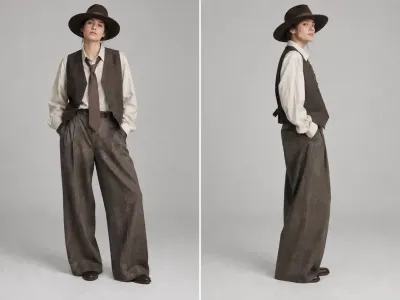
I'll admit this is a silhouette named after a movie costume, which usually makes me suspicious of how much real cultural weight it actually carries - but this one genuinely earns the entry. Diane Keaton's wardrobe in Woody Allen's 1977 Annie Hall, credited to Ralph Lauren, got adopted directly off the screen and into ordinary women's closets in a way that few costume-driven trends manage.
The shape itself is deliberately borrowed and deliberately oversized: a man's vest or waistcoat, a loosely knotted tie, high-waisted wide-leg trousers instead of a skirt, a button-down shirt with room to spare, topped with a wide-brimmed hat - nothing tailored to skim the body the way a fitted women's suit would. It reads as men's clothing worn by a woman rather than menswear reinterpreted for a female silhouette, and that distinction is the whole point. Yves Saint Laurent had already spent much of the decade laying the groundwork for this idea more formally through couture - his safari jacket and the broader menswear-borrowing running through his Rive Gauche collections gave the concept fashion-world legitimacy well before Keaton's off-the-cuff, thrift-store-adjacent version made it a street trend.
What actually gives this silhouette its staying power, I think, is how neatly it lines up with the real anxieties covered in the entry on dressing for work - a growing number of women were walking into offices that had, until very recently, been almost entirely male, and borrowing the visual language of authority directly from men's closets was one genuine answer to that problem. Annie Hall's rumpled, oversized layering wasn't corporate in the way John T. Molloy's dress-for-success suiting was, but it drew from the same well: menswear as a shortcut to being taken seriously, worn loose and a little askew rather than fitted, which is exactly what made it feel like something a real woman had thrown together rather than a costume department's idea of one.