The 1970s 1970s
Second-Wave Feminism and Dressing for Work
As real numbers of women moved into white-collar offices through the decade, what to actually wear there became a genuine, anxious, well-documented question - not just a style choice.
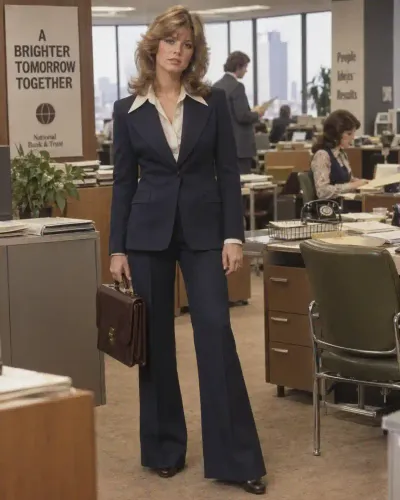
This is one of the entries where I think the legal and economic backdrop actually matters as much as anything on a runway. Title IX passed in 1972, opening up education and, downstream of that, career tracks that had been effectively closed to women; the Equal Credit Opportunity Act of 1974 meant a woman could get a credit card or a loan in her own name without a husband's co-signature for close to the first time at real scale. Neither of those is a fashion law, but both fed directly into a genuinely larger, faster-growing population of women entering white-collar offices through the decade than in any previous one - and offices at the time had essentially no established, off-the-rack dress vocabulary built for women who intended to be taken seriously in them.
That gap produced real anxiety, and it produced a genuinely controversial artifact worth naming directly: John T. Molloy's Women's Dress for Success, published in 1977, which advised women to dress in ways that mimicked male authority signals - structured jackets, muted colors, minimal decoration, skirts rather than trousers in his specific recommendations - based on his own market research into what "read" as competent to (mostly male) colleagues and bosses. It's easy to find Molloy's book a little grim in hindsight, prescriptive and openly premised on women needing to visually neutralize their femininity to be believed - but I think it's genuinely useful precisely because it's so blunt about an anxiety that was real and widely shared at the time, not manufactured by one book alone.
What women's ready-to-wear actually offered as an answer, rather than Molloy's specific prescriptions, is more interesting to me: menswear-inspired separates - blazers, vests, ties, trousers - worn on women's own terms rather than as costume, epitomized by the Annie Hall silhouette that broke into the mainstream in 1977. Yves Saint Laurent, whose Le Smoking tuxedo predates this decade but whose influence runs straight through it, had already made the underlying argument years earlier: that borrowing menswear's authority didn't have to mean surrendering femininity to get it. That's really the throughline of this whole entry - real legal and economic change opening the office door, and fashion spending the rest of the decade working out, not always gracefully, what walking through it should actually look like.