The 1970s early 1970s
The Bohemian/Prairie Silhouette
A loose, flowing, floor-grazing shape that carried late-60s hippie dressing straight into the mainstream - peasant blouses, gathered waists, and a lot of unstructured layering.
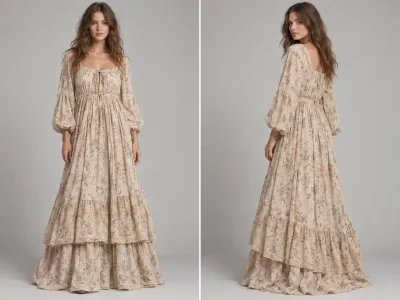
I think this is the silhouette that most people actually picture when they hear "1970s," even though it really only dominates the first half of the decade before disco and the wrap dress pull things in a different direction. The shape itself isn't complicated to describe - loose through the body, gathered or smocked at the waist rather than fitted to it, sleeves full enough to billow, hemlines dropping all the way to the floor - but it's doing a lot of cultural work underneath that simplicity.
This is really the late-1960s counterculture look losing its edge of protest and becoming something a department store could sell at scale. The peasant blouse and the maxi dress are the two garments doing most of the heavy lifting here, both drawing loosely on Eastern European and Mexican folk dress - embroidery, smocking, drawstring necklines - filtered through a Western fashion lens that was more interested in the general feeling of "natural" and "unfussy" than in any specific tradition. Laura Ashley is the anchor most worth naming on the more commercially respectable end of this look - her designer entry covers the cottage-prairie register specifically - but the same silhouette also shows up in a rawer, more genuinely countercultural form through the decade's early years, layered with fringe vests and worn without much regard for whether pieces technically "matched."
What I find genuinely interesting about this silhouette is how directly it maps onto the back-to-nature movement running alongside it - a gathered waist and a floor-length hem aren't just aesthetic choices, they're a rejection of the fitted, structured, girdle-dependent shape that had defined womenswear for most of the century before. Loose clothing doesn't require the same underpinnings, doesn't dictate the same body discipline, and reads as handmade or at least hand-adjacent even when it wasn't. That's the throughline I keep coming back to with this one: the silhouette looks soft, almost sentimental in photographs now, but it was a real and pointed departure from what a "well-dressed" woman's shape was supposed to be just a few years earlier.