The 1970s early-to-mid 1970s
Patchwork and Home-Sewing Culture
Home sewing hits its commercial peak just as patchwork, appliqué, and visible mending become a deliberate aesthetic statement rather than a sign of thrift.
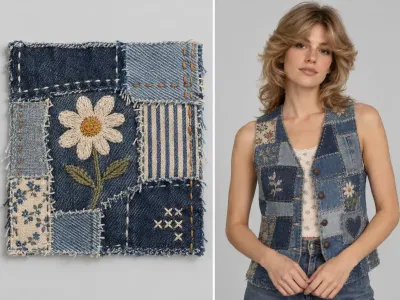
Home sewing had been in a slow decline through the affluent 1960s, ready-to-wear getting cheaper and more available every year, so it's a genuine reversal that the early-to-mid 1970s show a real bump in home-sewing activity - McCall's, Simplicity, and Vogue Patterns all report strong sales through these years, and pattern envelopes themselves start featuring exactly the boho and patchwork looks the decade is known for, rather than lagging a season or two behind ready-to-wear the way pattern companies often do. That's worth sitting with: this is a moment when the home-sewing industry is actively chasing a specific counter-cultural aesthetic, not just offering a cheaper way to get last year's department-store silhouette.
The actual construction technique matters here, because "patchwork" covers a few genuinely different methods that all show up on 1970s garments. True pieced patchwork - individual fabric scraps, often mismatched denim or calico, joined edge to edge with a seam allowance the way a quilt block is built - shows up on skirts, vests, and bags, usually hand- or home-machine-sewn since it's fiddly, low-volume work poorly suited to factory production runs. Appliqué is different and more common on mass-produced denim specifically: a separate patch, sometimes a purchased iron-on or sew-on novelty design, stitched or bonded onto the surface of an existing garment rather than pieced into its structure. And then there's visible mending and embroidery worked directly onto worn spots - a frayed knee or seat reinforced with a contrasting patch and decorative stitching rather than an invisible, color-matched repair - which is really the construction technique that most directly embodies the decade's values shift: a repair that announces itself as a repair, on denim specifically, was a genuine departure from earlier decades' assumption that visible mending signaled you couldn't afford new clothes.
That last point is really the throughline for the whole entry. Patched and embroidered denim in this period reads as a values statement more than a thrift measure - closely tied to the back-to-nature movement's broader suspicion of mass consumption and its preference for handmade, visibly imperfect goods over anything that looked machine-uniform. A young woman with real disposable income might still choose to patch a perfectly good pair of jeans by hand, and that choice - deliberately signaling craft and individuality over new-bought conformity - is the actual cultural content behind a construction technique that, on the surface, just looks like a scrap of fabric sewn onto another scrap of fabric.