The 1970s 1970s
Denim
The decade denim finally stopped being just workwear and youth rebellion and became something designers were willing to put their own name on.
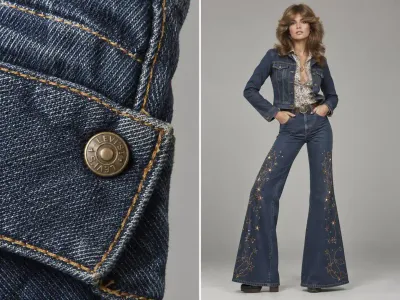
Denim had already done its rebellion work by 1970 - Levi's and Wrangler had spent the '50s and '60s as the fabric of greasers, then folk singers, then campus protest, always coded as a deliberate stepping-outside of respectable dress. What actually happens across the 1970s is denim losing that oppositional charge almost entirely and becoming, instead, simply what everyone wore, cutting across class and age in a way it genuinely hadn't before.
The garment doing the heaviest lifting here is the bell-bottom, which took denim from a purely casual, work-and-rebellion fabric into something flared, fitted through the hip and thigh, and worn as a real fashion statement rather than just tough workwear. But the more telling shift is what happens to denim's decoration through the decade: home-embroidered flowers, iron-on patches, macramé trim, and hand-applied patchwork turned a plain pair of jeans into a genuinely personal, often labor-intensive craft object - a real extension of the home-sewing and mending culture I get into more in the patchwork and home-sewing entry. None of that embellishment was factory-applied at first; it came from actual owners sitting with a needle and a pattern, which is part of why denim reads as such a genuinely democratic fabric for this decade specifically.
By the back half of the '70s, that democratic reputation collided with something new: designer denim, arriving properly with Calvin Klein's and Gloria Vanderbilt's tightly branded, tightly cut jeans lines toward 1978-79, putting a recognizable name (and a much higher price tag) on a fabric that had spent thirty years being explicitly anti-status. I think that collision is the real story of denim in the '70s - it starts the decade as the fabric that refuses hierarchy and ends it being sold back to the same market as a status symbol with a stitched-on signature, without ever stopping being casualwear in between. Not many fabrics manage both jobs inside a single decade.