The 1960s late 1960s
The Hippie Silhouette
Loose, floor-grazing, and unstructured - the counterculture's answer to a decade that had spent its middle years obsessed with hemline and geometry, three years before the 1970s claims the same shape as its own.
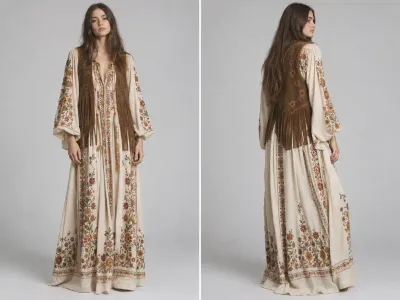
By 1967, the decade does something almost nobody predicts four years earlier when Courrèges is sending white vinyl boots down a Paris runway: it reverses direction on silhouette entirely. Instead of getting shorter, tighter, and more geometric, the newest look coming out of San Francisco and, close behind, London's Kings Road gets longer, looser, and far less concerned with structure of any kind - flowing kaftans, loose peasant blouses, ankle-length skirts, fringed vests, layered over each other with no interest in a single fitted line anywhere on the body.
This is worth calling out as its own entry rather than folding into "late-60s fashion" generally, because the construction philosophy is a genuine 180 from everything else this decade produced. Where mod and Space Age dressing prized flat, engineered simplicity - two pattern pieces, a crisp geometric edge, synthetic fabric holding its own shape - hippie dressing goes almost entirely the other way: natural fibers, unfinished or fringed edges, garments that drape according to the body's actual movement rather than a designer's imposed geometry, frequently handmade, mismatched, or sourced secondhand rather than bought as a coordinated look off a rack. Psychedelic prints carry a lot of the visual energy that geometric mod prints used to carry, just applied to a completely different silhouette.
I think this entry earns its place specifically because of what comes right after it: readers of the 1970s section will recognize this shape almost exactly as the bohemian/prairie silhouette that opens that entire decade. The hippie silhouette isn't really a 1960s phenomenon that fades out - it's the seed of the next decade's dominant early look, developed and worn by a genuine counterculture years before it gets absorbed into mainstream ready-to-wear. Tracking where a silhouette actually starts, rather than where it gets most widely sold, is exactly the kind of continuity I want this whole multi-era project to be able to show.