The 1960s late 1960s
The Kaftan
A loose, floor-length robe borrowed from North African and Middle Eastern dress, adopted by the late-decade counterculture as the clearest possible rejection of the mini's tight, engineered geometry.
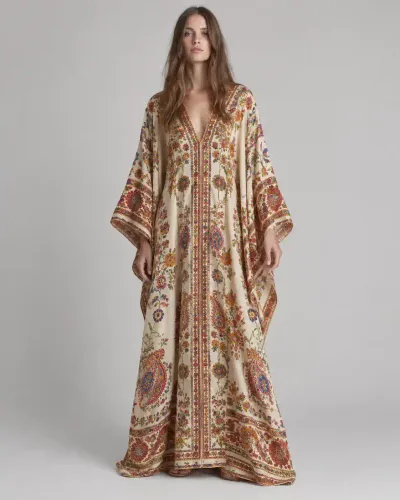
Very little about the kaftan's actual shape changed when the counterculture adopted it in the late 1960s - it's still the same loose, wide-sleeved, floor-length robe worn across North Africa and the Middle East for centuries, generally left uncut and unfitted, closing at the neck or worn fully open over other layers. What changed was who was wearing it, in what context, and what wearing it was understood to mean, which makes it a genuinely interesting garment to track even without much construction news to report.
Coming directly off several years of the mini skirt and the tightly-controlled geometric mod silhouette, a garment offering literally the opposite - full-body coverage, zero fitted shaping, fabric hanging loose from the shoulders - read as a deliberate statement in itself. Worn in bold psychedelic prints or richly embroidered natural fabrics, often by both men and women in a way that further blurred the decade's gender lines in dress, the kaftan let the wearer opt out of the mini's whole logic of youth, exposed leg, and tight engineering without opting out of bold color or pattern.
This is also one of the clearest places to see this decade handing something directly to the next one: readers who've spent time in the 1970s section will recognize the kaftan immediately as a direct ancestor of that decade's own bohemian and "ethnic-influenced" dressing, right down to the same borrowed silhouette and the same underlying instinct to signal a rejection of mainstream, mass-produced fashion. The garment barely changes shape crossing the decade line; what changes is scale, as a genuine counterculture item worn by a committed minority late in the 1960s becomes a much more mainstream boho staple within just a few years.