The 1940s wartime (1942-1945)
The Girdle and the Rubber Shortage
When Japan's advance in 1942 cut the Allies off from most of their natural rubber, elastic all but vanished from civilian foundation garments - and girdles went back to lacing, boning, hooks, and clever cutting.
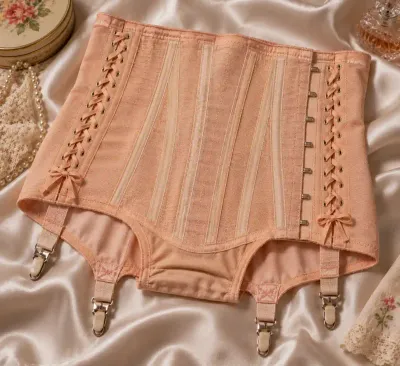
By the late 1930s, most women's foundation garments relied heavily on elastic - rubber thread wrapped in fabric, woven into girdles, roll-ons, and garter belts. Compared with the fully boned corsets of earlier decades, a stretch girdle gave a smooth line with far more freedom of movement. Then, in early 1942, Japan's advance through Southeast Asia cut the Allies off from the plantations that supplied most of the world's natural rubber, and rubber became one of the most tightly controlled materials of the war.
Elastic for civilian use was drastically restricted, and the effect on underwear was immediate. Foundation garment makers went back to older construction methods: firm woven fabrics shaped by seaming and darts, side lacing and hook-and-eye closures, and boning (which, with steel also in short supply, might be made of other materials) to give control without stretch. Some garments used short elastic panels only where they were really essential. Knicker elastic was replaced by buttons or drawstrings in many homemade versions. Women were also urged to look after the girdles they already had, since replacing them wasn't easy.
What I find fascinating is that foundation garments were treated as a genuine wartime issue rather than a frivolous one. The corsetry industry argued that proper support mattered for women doing heavy physical war work, and firm foundation garments remained part of how many women felt properly dressed, especially for the shaped look of the sweater girl silhouette. When synthetic rubber and, later, new elastic fibres became widely available after the war, girdles came roaring back - which sets up the heavily engineered foundation garments of the 1950s.