The 1940s throughout the 1940s
Nylon and the Stocking Shortage
DuPont's new wonder fibre launched as women's stockings in 1940, vanished into parachutes by 1942, and came back in 1945-46 to literal riots - with painted-on 'stockings' filling the gap in between.
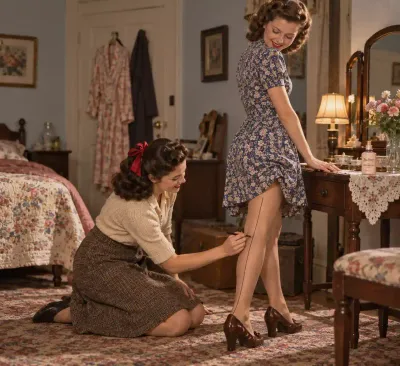
Nylon has one of the most dramatic stories of any fabric in this whole project, and almost all of it happens in the 1940s. DuPont had developed the first fully synthetic fibre in the 1930s, and it chose women's stockings as its big consumer launch. Nylon stockings went on sale nationally in the US in May 1940 and sold in enormous numbers almost immediately - they were sheerer than cotton or rayon and far more durable than silk, and women loved them.
Then, barely eighteen months later, they disappeared. Once the US entered the war, nylon production was diverted to the military, for parachutes, tyre cords, ropes, and tents, and new nylons for civilians essentially stopped. Silk stockings had already gone the same way. Women fell back on cotton and rayon stockings, which bagged at the knee and ankle, or on nothing at all - and that's where one of my favourite wartime improvisations comes in. Leg makeup, sold as lotions and creams or improvised at home with anything from gravy browning to cocoa, was used to tint bare legs a "stocking" shade, and a friend with a steady hand and an eyebrow pencil would draw a seam line up the back of the leg. In Britain, where stockings were also on the coupon ration, the same trick was just as common.
When nylon stockings finally returned after the war, demand was so far beyond supply that the queues turned into what newspapers called "nylon riots" in 1945 and 1946, with crowds of women lining up for a limited number of pairs - at the worst, in Pittsburgh in 1946, some 40,000 people queued for around 13,000 pairs. I think that tells you how much a small, everyday luxury matters after years without it. Nylon went on to become one of the defining fabrics of the 1950s, but it's worth remembering that its first five years on the market were mostly about its absence - and that some of it had spent the war as the parachutes that brides later turned into wedding dresses.