The 1940s wartime (1942-1945)
The Bobby-Soxer Look
Folded-down ankle socks, saddle shoes or loafers, a pleated skirt and an oversized 'sloppy joe' sweater - the uniform of the teenage girls who screamed for Sinatra, and one of the first real teenage fashion looks.
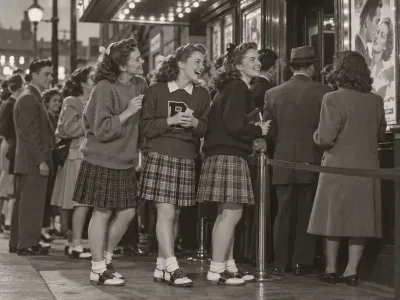
The 1950s section talks about teen fashion becoming a huge market, but it notes that the real starting point was the war years. This entry is about that starting point: the "bobby-soxers," the American teenage girls of the early and mid-1940s, and the look named after their socks.
The key item was the bobby sock itself - a white or pastel ankle sock, usually folded down at the cuff. Those were worn with flat, comfortable shoes: saddle shoes, loafers, or moccasins. Above that came a pleated or gathered skirt, often a dirndl or a plaid, around knee length, and on top a big, loose sweater nicknamed a "sloppy joe," or a borrowed man's shirt worn with the sleeves rolled up. Hair was often long and tied back with a ribbon or a scarf, and a string of pearls or a charm bracelet was a popular touch.
Part of the reason the look caught on was practical. With nylon and silk stockings almost impossible to get during the war, ankle socks with bare legs made sense for girls who were still at school. But it quickly became something more: a deliberate, collective style that marked out teenage girls as a group, distinct from both children and adult women. The oversized sweater, in particular, was the opposite of the fitted sweater girl look older women wore - comfortable, loose, and borrowed from boys.
The bobby-soxers became famous as fans. The young Frank Sinatra's shows at New York's Paramount Theatre between 1942 and 1944 drew crowds of screaming teenage girls, and newspapers were fascinated and a bit alarmed. Magazines and manufacturers noticed that these girls had money and opinions, and Seventeen magazine launched in 1944 to reach them. That's why I think the bobby-soxer look matters so much: it's the moment teenagers became a fashion market with their own clothes. The saddle shoes, pleated skirts, and big sweaters flowed directly into the teenage uniform of the 1950s, and there's a straight line from these girls to every youth fashion that followed.