The 1940s throughout the 1940s
The Dirndl Skirt
A full skirt gathered onto a waistband, borrowed from Alpine folk dress - a pre-war craze squeezed small by wartime fabric rules, still sewn at home from remnants, then let loose again in the years after 1945.
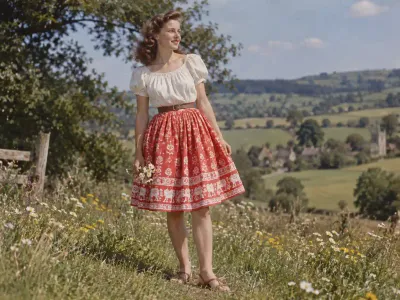
The dirndl skirt is a good example of how a garment's fortunes in the 1940s depended less on taste than on fabric. It was very fashionable just before the war, awkward during it, and hugely popular again as soon as it was over.
The word comes from the traditional dress of Bavaria and Austria, where a dirndl is a whole outfit: a fitted bodice, blouse, full skirt, and apron. What fashion borrowed in the late 1930s was mainly the skirt - a straight rectangle of fabric gathered tightly onto a waistband so it puffed out over the hips and fell in soft folds. It was often made in bright cotton prints, checks, or embroidered and braid-trimmed fabrics that nodded to its folk origins, and worn with a peasant-style blouse or a fitted sweater. The folk look, including Alpine and Tyrolean touches, was a big trend in both Europe and the United States just before the war.
The skirt's great strength was simplicity. A dirndl is about the easiest skirt there is to sew: a rectangle, a waistband, a gathering thread, and a placket. You didn't need a pattern, and it fitted a range of figures because the gathers did the work. That made it a favourite of home sewists, and of the new American sportswear designers - including Claire McCardell - who valued easy, unfussy clothes.
The war made it tricky, because a gathered skirt uses more fabric than a gored or straight one. Wartime rules in Britain and the US limited skirt widths and hem circumferences, so ready-made skirts shifted toward gored and slim shapes. But the dirndl never disappeared. Home sewists could still make modest versions from remnants, old dresses, or even feedsack cotton, and it suited the sweater-and-skirt look perfectly. There was also an uncomfortable side to the folk revival in Europe, where the Nazi regime promoted traditional dress as a symbol of national identity - something American wearers of the fashion were probably largely unaware of.
After 1945, as fabric returned, the dirndl was back in full force, and wider than before. Its full, gathered volume sits right on the path to the postwar softening and the New Look's full skirts, and it led into the gathered skirts of the 1950s. I'd recommend it to any beginner who wants to sew something 1940s: it's the simplest period skirt you can make, and it looks lovely.