The 1940s wartime (1941-1945)
Wartime Lingerie and Utility Underwear
Knickers, slips and petticoats on the ration - plain utility underwear without embroidery, rayon locknit instead of silk, service-issue knickers nicknamed 'passion killers', and a great deal of homemade lingerie cut from whatever fabric came to hand.
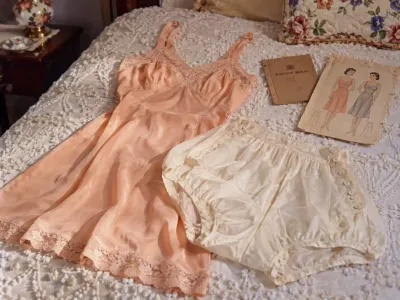
The 1930s left behind a beautiful legacy of bias-cut slips and satin lingerie. The war years had to make do with much less, and I think what women wore underneath in the 1940s tells you as much about wartime life as anything they wore on top.
In Britain, underwear was on the clothing ration from 1941, so knickers, slips, and petticoats cost precious coupons alongside dresses and coats. The utility and restriction orders cut out purely decorative extras - from June 1942, lace, embroidery, and appliqué were banned on new underwear and nightwear - so utility lingerie was plain and practical: simple cuts, no new lace or embroidery, and hard-wearing fabrics. Silk had largely disappeared from the shops, and the everyday alternative was rayon, often in a close, run-resistant knit called locknit, in shades of peach, "tea rose" pink, white, and pale blue.
Women in the services and in war work had their own versions. The women's services issued plain, sturdy knickers - the WAAF's knee-length pairs came in navy for winter and pale blue for summer - which servicewomen nicknamed "passion killers," and many women doing factory work simply wore whatever was warmest and most practical under their overalls. Elastic itself was scarce, because of the rubber shortage, so many homemade knickers fastened with buttons or drawstrings instead of an elastic waist.
Home sewing filled the gaps. Lingerie needs relatively little fabric, so it was an ideal make-do-and-mend project. Women cut knickers and slips from old nightdresses, worn-out blouses, and petticoats; unpicked lace from old lingerie to reuse; and, when they could get it, used parachute fabric, which was fine, light, and pale - ideal for underwear. In rural America, printed feedsack cotton turned into slips and underwear as well as dresses. Magazines published patterns for camiknickers and slips that could be made from very small pieces of fabric.
I have a soft spot for this subject because it's so hidden. These garments rarely survive, since they were worn until they fell apart and then cut up again. But they show how deeply rationing reached into daily life, right down to the layer nobody saw - and the lengths women went to, even there, to keep a little bit of prettiness.