The 1940s wartime (1941-1945)
Rosie the Riveter and War Work
Millions of women moved into factories, shipyards, and the services during the war - bringing overalls, trousers, headscarves, and practical hair into everyday life, and a famous poster that almost nobody saw at the time.
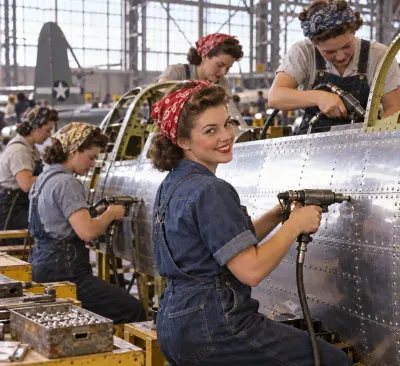
When most people picture the wartime woman worker today, they see the "We Can Do It!" poster: a woman in a blue work shirt and red polka-dot headscarf, flexing her arm. It's one of the most famous images of the 1940s. The funny thing is that at the time, hardly anyone saw it. J. Howard Miller made it in early 1943 as an internal morale poster for Westinghouse factory workers, and it was put up for just two weeks that February before being forgotten for decades. It became iconic in the 1980s, when it was rediscovered and adopted as a feminist symbol. The Rosie that 1940s Americans actually knew came from a popular 1942 song and Norman Rockwell's 1943 Saturday Evening Post cover of a muscular riveter eating lunch.
The reality behind both images is huge. In the US and Britain, millions of women took jobs in factories, shipyards, munitions plants, and transport, or joined the auxiliary services and Britain's Women's Land Army. That meant new clothes: overalls, boiler suits, dungarees, and trousers for work, and hair tied up in a turban or headscarf for safety. Factories and government campaigns issued advice on safe work clothing, and in 1943 Veronica Lake famously pinned up her long peek-a-boo hair to encourage women war workers to keep theirs out of the machinery.
I think what's most interesting here is how work clothes crossed over into fashion. Magazines ran features on smart workwear, department stores sold coordinated overalls and slacks, and the capable, practical woman in trousers and a headscarf became a fashionable image in her own right, not just a necessity. After the war, many women were pushed out of their jobs as men returned, and fashion swung back toward the full skirts of the New Look. But the idea that a woman could wear trousers and look good doing real work never fully went away, and I think that's one of the decade's most lasting legacies.