The 1940s wartime (1941-1946)
The Utility Silhouette
Squared, padded shoulders over a narrow waist and a short, slim skirt stopping just below the knee - the defining wartime shape, and one dictated as much by fabric regulations as by taste.
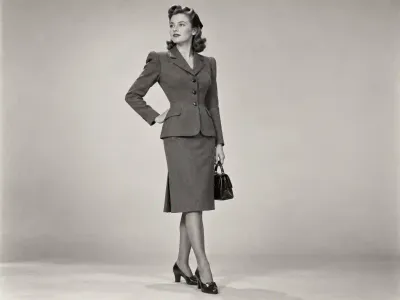
If you picture "1940s" and see a woman in a neat, boxy-shouldered jacket and a skirt hitting just below the knee, this is the shape you're picturing. It's worth starting the era here because it's the one silhouette of the decade that was, quite literally, written into law. Britain's Utility scheme and America's L-85 order (both covered properly in the restrictions entry) capped how much cloth a garment could use, and this silhouette is what you get when you design right up to those caps and no further.
The shape itself is easy to describe: a strong, squared shoulder built up with shoulder pads, a defined but not cinched waist, and a slim or gently flared skirt with just enough pleating to walk in and not a single pleat more. What's genuinely clever about it, and what I think gets overlooked, is how much work that big shoulder is doing. Padding the shoulder costs almost no fabric, but it makes the waist look smaller and the hips look narrower by contrast - so a wartime designer who wasn't allowed a full skirt could still produce a proportion that read as feminine and deliberate rather than skimpy. The shoulder is the silhouette's one extravagance, and it's an extravagance made of wadding rather than yardage.
It also borrows, unmistakably, from uniform. With millions of women either in service or in uniformed war work, a squared, military-adjacent line didn't look austere so much as current - patriotic, capable, of its moment. The utility suit is the purest version of it, but you see the same logic in day dresses and coats too. And because it's a shape built on rules, it's also the shape the rest of the decade eventually reacts against: the moment those rules loosen, fashion reaches straight for everything the utility line denied it, which is the whole story of the postwar softening and, eventually, the New Look.