The 1940s wartime (1942-1946)
The Utility Suit
A single-breasted jacket and knee-length skirt, cut to government fabric limits and carrying Britain's CC41 label - the wartime suit that proved rationed clothes could still be well designed.
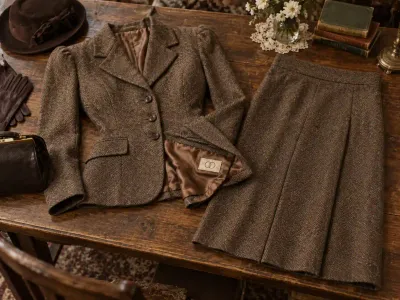
If one garment stands for this decade, it's the skirt suit - and the most distinctive version of it is the British Utility suit. It's the utility silhouette in its purest form: a hip-length, single-breasted jacket with squared, padded shoulders and a neat collar, over a straight or gently flared skirt stopping just below the knee, with a couple of pleats at most for walking room.
What makes it a garment worth its own entry rather than just an example of the silhouette is the label. Utility clothing carried the CC41 mark - "Civilian Clothing 1941" - with its two distinctive interlocking circles, which told the buyer the garment was made to the government's Utility specifications: a set amount of cloth, a capped number of buttons and pockets, no purely decorative trim. In return, Utility goods were price-controlled and exempt from purchase tax, and the cloth itself had to meet quality standards. That's a detail I think gets lost: Utility wasn't meant to be cheap in the shoddy sense. It was meant to be decent, durable cloth at a fair price, and the good versions were properly well made.
The best-known Utility suits came out of the 1942 collaboration with London's couturiers, including Norman Hartnell, who were asked to prove that clothes built inside these rules could still look smart. Mostly, they did. Every detail had to justify its fabric, so a Utility suit's interest comes from cut, proportion, and the odd clever seam rather than from ornament. Because a suit was also one of the biggest single spends in a coupon allowance, it was worn hard, mixed with different blouses and knits to stretch it across the week, and remade when it wore out. Vintage Utility suits that survive today tend to show it - and I love them all the more for that.