The 1940s wartime (1942-1945)
Button and Zipper Shortages
With metal diverted to the war effort, zippers became scarce and button counts were capped - pushing garment closures back toward snaps, hooks, side plackets, and buttons in wood, glass, and plastic.
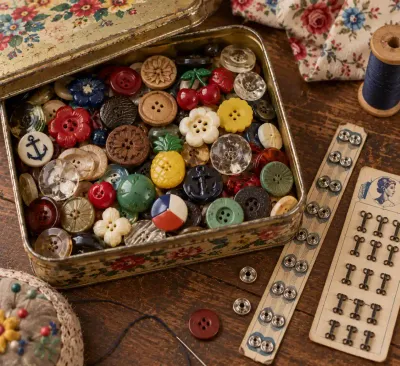
Closures are one of those details you only notice once you start looking at a lot of garments from a particular decade, and 1940s closures are a real mix. That's not carelessness - it's the fingerprint of a supply problem. Zippers were still fairly new in women's dresses at the start of the decade, and once metal was prioritised for the war effort, zippers for civilian clothing became hard to find, since the military needed them for flight suits, bags, and equipment.
So dressmakers and manufacturers went back to older methods, or mixed and matched. Dresses often closed with a side placket held by a row of metal press-studs (snaps) and hooks and eyes, which use much less metal than a zipper. Trousers and skirts used buttoned plackets. Where zippers did appear, they were often short, and some were made with plastic teeth. When you look at a lot of 1940s dresses side by side, you see just how inconsistent it is - the same basic style might close with a zip, snaps, or buttons depending on when and where it was made.
Buttons had their own problems. In Britain, the Utility restrictions capped how many buttons a garment could have, so designers made the few they were allowed count. Materials shifted away from metal to plastics, glass, wood, carved bone, and even ceramic, and novelty buttons became one of the few places left where a garment could be playful - fruit, animals, military motifs, and bright colours. Home dressmakers kept button tins and moved buttons from garment to garment, which is why vintage 1940s buttons turn up in such interesting combinations. The zipper came back quickly after the war, as the 1950s entry on the zipper's spread covers, but 1940s closures are a small, very human record of making do.