The 1950s 1950s
The Zipper's Spread
Metal zippers became a fully standard closure in women's fashion during the 1950s - not because they were new, but because they'd finally recovered from wartime metal restrictions that had curtailed their use since the early '40s.
The real story here isn't as simple as "zippers arrive in the '50s" - they'd already started appearing in dressy womenswear by the mid-to-late 1930s, most famously via Schiaparelli's deliberately visible use of them from 1935 onward, though still more novelty than standard closure at that point. What actually happened is the War Production Board's metal restrictions from 1942 pushed zippers back out of civilian clothing for the duration of the war, so what the 1950s represents is more of a full recovery and standardization than a first arrival. Earlier garments (see the Victorian section) relied entirely on hooks, eyes, and buttons - no zipper at all, at any point.
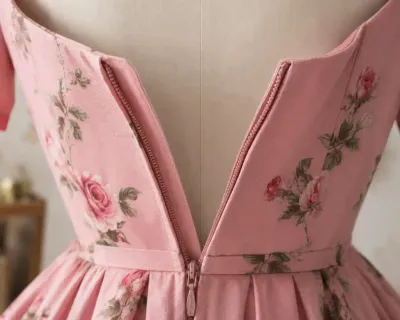
Placement is a genuinely useful dating tool if you're ever examining an actual period garment. Earlier in the decade, a side-seam zipper - set into the left side seam, roughly under the arm - was still extremely common, a placement carried over largely unchanged from prewar and wartime dressmaking practice, chosen because it kept the closure discreet without requiring any special construction beyond what a side seam already needed. As the decade moves on and fitted silhouettes like the wiggle dress demand a smoother, more continuous line through the torso, center-back zippers become increasingly standard - running from the neckline or a few inches below it straight down the spine, which avoids any visible interruption at the side of a tightly fitted bodice and lets the front of the garment present one clean, unbroken surface.
That shift also tracks a broader move in how ready-to-wear manufacturing was thinking about visible construction quality. A center-back zipper is genuinely more demanding to install well - it has to lie perfectly flat against the spine's curve, with no puckering, in a spot the wearer can't easily check herself in a mirror - so its rise as the standard placement says something about factories and home sewists alike getting more confident with the technique, not just about changing silhouette preferences. By the end of the decade, a center-back zipper had become close to the default assumption for a well-made fitted dress, a small construction detail quietly signaling the same postwar recovery and standardization discussed above, just expressed through where a closure sits rather than through the zipper's presence at all.