The Victorian Era Late Victorian / early Gibson Girl (1890s)
The Tailor-Made Walking Suit
A tailored jacket-and-skirt combination borrowed from menswear tailoring, built for actually walking rather than standing decoratively - a real shift in what dress was for.
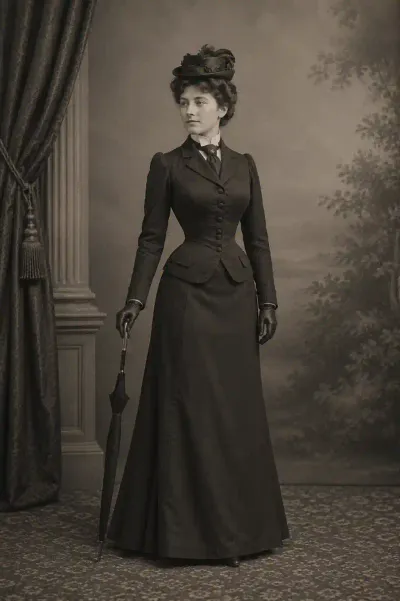
The walking suit is where you can feel the Victorian era starting to loosen its grip - a garment genuinely built for movement, tailored with the same precision as menswear, pointing straight at the more athletic Edwardian ideal that follows.
The technique transfer from menswear is the real story here, and it's more literal than it might sound - this isn't dressmaking borrowing a general aesthetic, it's tailoring houses like Redfern applying actual men's-jacket construction methods to a woman's garment for arguably the first time. That means canvas interfacing built into the chest and lapels to hold their shape independent of the body underneath, a properly set sleeve with a defined armhole rather than the softer, more forgiving cut a dressmaker's bodice typically used, and structured shoulders shaped through pressing and internal padding rather than gathers or drapery. The skirt half of the pairing was comparatively plain and close-fitting - often gored to fall smoothly without any bustle or crinoline underneath at all by this point - which threw even more visual weight onto the jacket's crisp tailoring.
What made the style spread as fast as it did was exactly what it was designed for: it worked. A walking suit held its shape through a genuinely active day - walking, travel, the new fashion for cycling and lawn sports - in a way a soft dressmaker-made bodice simply couldn't, and once wealthy, visible women started wearing tailoring this precise, demand for it moved down through the same fashion-plate and department-store channels that spread every other Victorian trend. By the 1890s the tailor-made suit had become close to a uniform for a certain kind of modern, mobile woman, menswear-derived construction and all, and its logic - structured tailoring married to genuine function - is really the throughline connecting the era's very end to the more overtly practical dress that follows through the Edwardian period and beyond.