The Victorian Era Victorian era, broadly
The Riding Habit
A tailored jacket, a long side-saddle skirt, trousers underneath and a top hat - made by men's tailors rather than dressmakers, and later redesigned as the 'safety skirt' because the old version could kill.
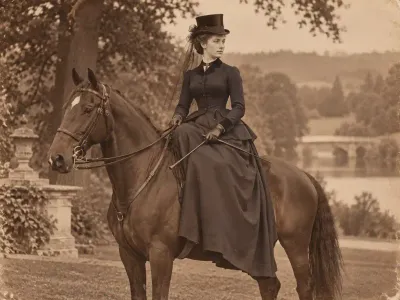
The riding habit is easy to overlook as a specialist sports outfit, but I think it's one of the most important garments in the whole Victorian wardrobe. It had long been the one place where women's clothing was routinely made by men's tailors, and it quietly paved the way for the tailored suits that end the century.
For most of the era, women rode side-saddle, with both legs on the same side of the horse, so the habit was designed around that position. It had three main parts. On top was a close-fitting jacket or bodice, cut and made like a man's coat from firm woollen cloth, with neat collars, buttons, and precise seams. Below was a long skirt, originally very long and full, which draped over the legs and hung down the horse's side. Underneath, women wore trousers or breeches, usually in matching fabric or chamois leather, for modesty and comfort. A top hat or bowler, often with a veil, gloves, and boots finished the look, along with a shorter corset designed for riding.
Because the jacket needed the precision of a man's riding coat, habits were usually made by tailors rather than dressmakers. That mattered enormously. Tailoring used different techniques - firm wool, interlinings, pressing and shaping with a hot iron - and it produced a crisp, structured look very different from a dressmaker's bodice. Tailoring firms that specialised in riding habits, Redfern among them, later applied the same skills to women's walking clothes, producing the tailor-made walking suit that became the uniform of the 1890s "New Woman."
The long skirt also turned out to be dangerous. If a rider fell, the heavy skirt could catch on the saddle's pommels, leaving her trapped and dragged along by the horse. There were real deaths. From the 1870s, tailors developed so-called safety skirts - also called apron skirts - cut closely to the shape of the leg over the saddle, much shorter, and often open at the back or designed to come free in a fall. By the end of the century the skirt was little more than an apron over breeches. I find this a good example of how practicality forced change even within strict ideas of modesty. It also marks where women's riding was heading next: by the early twentieth century, some women were riding astride in divided skirts, and eventually in breeches alone.