The Victorian Era Late Victorian / early Gibson Girl (1890s)
Late Victorian / Gibson Girl (1890s)
Leg-of-mutton sleeves and the hourglass silhouette usher in a more tailored, athletic ideal that carries straight into the Edwardian era.
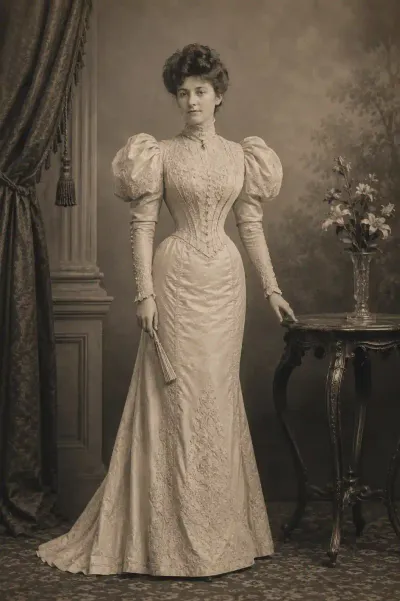
The Gibson Girl is where the Victorian era starts visibly loosening up - the tailored "walking suit" and a more mobile ideal of dress point directly at where fashion is headed next, even while corsetry is still very much doing its work underneath.
The tailored suit's rise is really the story here. Where the previous three decades were defined by what was happening to the skirt - crinoline, first bustle, natural form, second bustle - the 1890s shift the interesting action upward, to the bodice and sleeve. The leg-of-mutton sleeve (enormous through the upper arm, narrowing sharply at the elbow to a fitted forearm) does a huge amount of the silhouette's work, visually broadening the shoulder so the corseted waist beneath reads even smaller by contrast - a different route to the hourglass than anything the bustle years attempted, achieved through the upper body rather than a structure at the back of the skirt. Skirts themselves go comparatively plain: smooth over the hip, often gored rather than gathered so they fall in a clean bell without any bustle or pad underneath at all, which after fifty years of increasingly elaborate rear-projecting structures is its own small revolution.
That plainness below the waist pairs with the rise of the tailored "walking suit," borrowing construction logic straight from menswear tailoring - structured, close-fitting jackets meant for actual movement, worn by women bicycling, playing tennis, or simply walking through a city street rather than posing in a drawing room. I think this is the real hinge of the entry: the Gibson Girl isn't just a new shape, she's a new activity level, and dress is visibly adjusting to accommodate it even while the corset underneath hasn't gone anywhere yet. That tension - a more mobile ideal of womanhood, still built on a fully boned foundation garment - is exactly what carries forward into the Edwardian era's S-bend silhouette, and it's why I think this sub-period reads as a beginning as much as an ending.