The Victorian Era Late Victorian (1870s–1901)
Department Stores and Mail-Order Catalogs
The rise of the department store and the mail-order catalog put fashionable dress within reach of far more households than bespoke dressmaking ever could.
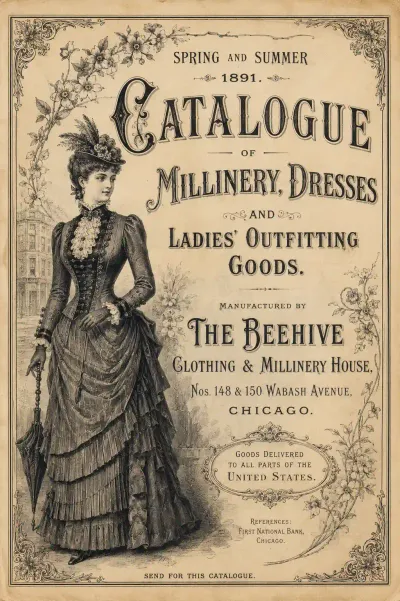
This is really the retail side of the ready-mades story - once a catalog could put a garment description and a price in front of someone who'd never set foot in a dressmaker's shop, fashionable dress stopped being purely a matter of proximity and money.
The department store side of this really begins with Bon Marché in Paris, generally credited as the first true department store when it expanded dramatically under Aristide Boucicaut starting in the 1850s and '60s - fixed prices instead of haggling, the radical idea of letting customers simply browse without any obligation to buy, and a scale of stock no individual dressmaker or small shop could match. London followed with stores like Whiteleys and, later in the century, Harrods and Selfridges (the latter just past this era's close), while American cities developed their own versions - Marshall Field's in Chicago, Macy's in New York - all working from the same basic new proposition: fashionable goods, displayed and priced for anyone who walked in, no personal relationship with a proprietor required.
Mail-order catalogs pushed that same logic even further, past the limits of geography entirely. In the United States especially, companies like Montgomery Ward (founded 1872) and Sears, Roebuck (catalog business from 1888) put illustrated pages of ready-made clothing, complete with prices and rough sizing, directly into rural households that might be a full day's travel from the nearest city shop. That's a genuinely different kind of access than anything the department store alone provided - it meant a farm family in a remote county could order roughly the same ready-made shirtwaist a city clerk's family was buying off a store shelf, collapsing a geographic gap in fashion access that had persisted the entire rest of the era. Between the two - browse-and-buy department stores in cities, catalogs reaching everywhere else - the last quarter of the century sees fashionable dress genuinely decouple from proximity to a dressmaker for the first time, which I think is as significant a shift as any single silhouette change covered elsewhere in this section.