The Victorian Era Second bustle phase (mid-to-late 1880s)
Bustle Era, Second Phase
The bustle returns, larger and more shelf-like than its 1870s predecessor, before collapsing again by decade's end.
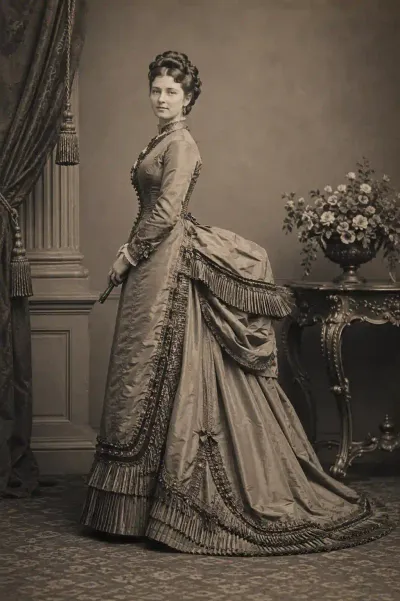
The second bustle is a genuinely strange, architectural shape - it juts out almost horizontally rather than draping the way the 1870s version did. I find it one of the most sculptural silhouettes in the whole Victorian span.
Comparing the two bustle structures directly is the best way to see how different this phase really is from its 1870s predecessor. The first bustle relies on soft drapery and a fairly modest pad or half-cage, with volume that swags and cascades under its own weight. The second bustle, by contrast, is a genuine piece of structural engineering again - wire or steel half-hoops, hinged so they could fold flat when the wearer sat down, projecting almost at a right angle from the small of the back before the skirt fabric drops straight down over them. The effect is closer to a shelf or ledge than to drapery, and it's exactly that rigidity that gives the silhouette its architectural, almost furniture-like quality. Trim in this phase tends to be more restrained and tailored than the fringe-heavy first bustle, too, which lets the structure itself read as the main event rather than getting buried under ornament.
I think this phase is also where you can see Victorian dress at its most confident about admitting it's an engineered object. There's no real pretense that this shape occurs naturally on a body - a wire cage is doing visible, almost sculptural work, and fashionable dress of the mid-1880s seems entirely at ease with that. It doesn't last, though: by 1889 the structure collapses again, fashion pulling toward the slimmer, more tailored lines that carry straight into the Gibson Girl silhouette of the 1890s. Two bustle phases, one decade apart, built on almost opposite engineering principles - soft drapery, then rigid cantilever - is, to me, one of the more striking things about the Victorian era's pace of change once you actually look closely at it.