The Victorian Era Crinoline era (1850s–1860s)
Crinoline Era
The cage crinoline replaces heavy petticoat layering, enabling the era's dramatic, rapidly-inflating bell-shaped skirts.
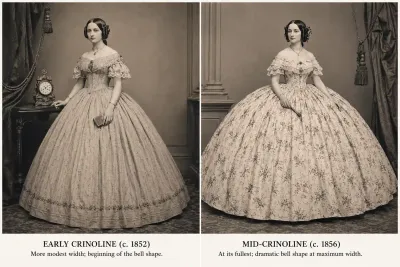
The steel cage crinoline's arrival around 1856 is one of those genuinely pivotal moments in dress history - suddenly the era's huge skirts didn't need six pounds of petticoat to hold their shape, just a light steel frame. (Exactly who invented it is genuinely disputed among costume historians - several French and English patents surfaced the same year - so I'm treating it as a shape that emerged rather than crediting a single inventor.)
What's easy to miss, if you've only ever seen a single "hoop skirt" photo from this period, is how much the shape itself moves during its own run. The earliest cage crinolines of the late 1850s are still fairly close to the fullness the preceding decade achieved with petticoats - the innovation at first is really about weight and mobility, not silhouette. But the shape balloons through the early 1860s into genuinely enormous proportions, hoops widening to roughly six feet in diameter at their peak around 1860–1863 (contemporary accounts describe some exceptional examples wider still), before the fashionable line starts pulling inward again and, more importantly, backward: by the late 1860s the crinoline has flattened at the front, elongated toward the back, and started collapsing into exactly the kind of rear-weighted volume that becomes the bustle. So "the crinoline era" isn't one shape held steady for twenty years - it's a shape inflating and then deliberately deflating, and if you only look at the middle of the decade you miss the whole story.
The engineering itself deserves real credit here. A cage crinoline is, structurally, a wearable piece of ironwork: a series of flexible steel hoops, graduated in size, held in vertical alignment by fabric tapes, worn under the skirt in place of the half-dozen petticoats the previous decade needed to fake the same volume. That's a genuine improvement in a wearer's life - lighter, cooler, and it let the skirt swing and sway in a way stacked petticoats never could, which contemporary illustrations clearly relish. It also introduced its own very real hazards (crinoline fires were a documented cause of death, skirts catching on doorframes and furniture were a running joke in the period press), which I think is worth remembering whenever the shape gets treated as purely decorative. It solved a problem and created new ones, the way most structural innovations do.
I'd also point anyone reading this toward the construction entry on the cage crinoline as structure if the actual hoop-and-tape mechanics interest you - this entry is about the silhouette it produced, but the engineering underneath is honestly the more interesting story.