The Victorian Era Crinoline era (1850s–1860s)
Cage Crinoline
A light steel-hooped frame that emerged around 1856 - credit is genuinely disputed among competing French and English patents - that replaced heavy layered petticoats and let skirts balloon dramatically without the weight.
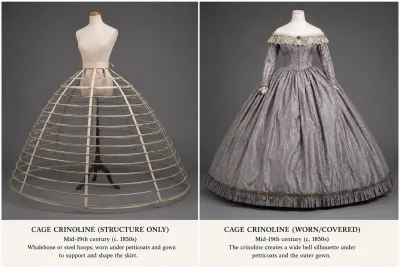
As an object, the cage crinoline is basically wearable engineering - a few pounds of steel hoops doing the work six layers of starched petticoat used to do, and doing it far more comfortably.
The pace of change is genuinely startling once you line up the shapes year by year. The earliest cages, from around 1856, are relatively modest - dome-shaped, closer in overall volume to what heavy petticoat layering had already been achieving. Within a few years the hoops grow dramatically, and by the early 1860s a fashionable crinoline could measure six feet or more around the hem, the dome flattening slightly at front and swelling further at the sides and back. Then, almost as quickly as it inflated, the shape starts collapsing again - by the mid-to-late 1860s the front hoops shrink toward the leg while volume is deliberately retained and increased at the back, which is the crinoline visibly turning itself into the bustle before the decade is even out. Owning a cage crinoline in this period basically meant needing a new one every couple of years just to stay in fashion, which says something about how commercially significant the garment was - hoop-skirt manufacturing became a real industry almost overnight.
Wearing one took some adjustment too, and contemporary sources are full of practical advice and complaints: doorways, carriage seats, and staircases all required a bit of technique, and the hoops had an unfortunate tendency to tip up if a wearer sat carelessly or bent forward. For the construction mechanics - how the hoops and tapes were actually assembled - that entry goes into more detail; this one is really about how fast a genuinely useful invention turned into a fashion object that outpaced its own practicality, ballooning to a size well beyond what the original comfort argument for it ever needed.