The Victorian Era Crinoline era (1850s)
Bloomer Costume
A short skirt worn over loose trousers gathered at the ankle - popularly named for Amelia Bloomer, though she didn't design it, and the dress reform movement's most famous, and most mocked, practical alternative to crinolines and corsets.
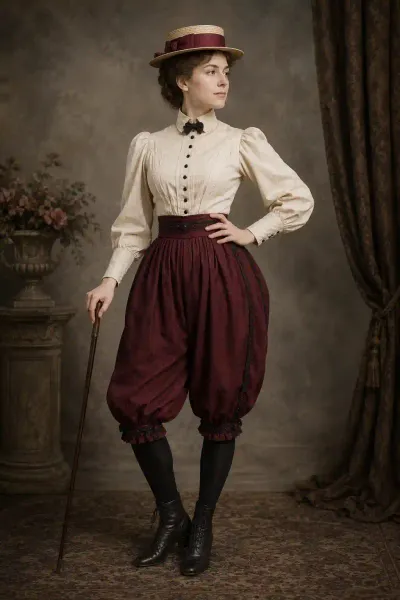
The bloomer costume gets treated as a punchline in a lot of casual fashion history, but it deserves its own entry - it's a genuinely serious attempt at practical dress reform, even though the public mockery meant it never really caught on beyond a small circle of reformers. Worth setting the attribution straight too: Elizabeth Smith Miller actually designed and first wore it in early 1851; she showed it to her cousin Elizabeth Cady Stanton, who introduced it to her friend Amelia Bloomer, who then publicized it so thoroughly in her newspaper The Lily that the public - and history - attached her name to it instead.
The ridicule was immediate and fairly vicious - newspapers and satirical magazines (Punch in particular) ran cartoon after cartoon mocking bloomer-wearers as unfeminine, mannish, or simply absurd, and crowds sometimes followed women wearing the costume in the street to jeer. Some of that hostility was aesthetic snobbery, but a good deal of it was something closer to genuine anxiety: trousers on a woman, even worn under a skirt, read at the time as a direct challenge to a social order that used clothing to draw a hard visual line between the sexes. Reform advocates were making a practical argument - that corsets and crinolines were unhealthy and restrictive, and that a shorter skirt over trousers was simply more sensible for actually moving through the world - but the public reaction treated it as a political and moral provocation rather than a wardrobe choice, which tells you how much cultural weight Victorian society hung on silhouette.
Most of the costume's original wearers, including Stanton and Bloomer herself, had quietly returned to conventional dress within a few years, less because they'd changed their minds about corsetry and crinolines than because the ridicule was actively undermining the causes - women's suffrage chief among them - that mattered more to them than the clothing fight itself. That's the part I find most telling: the bloomer costume didn't fail because it was impractical, it failed because Victorian society was willing to inflict real social cost on anyone visibly stepping outside its dress code. It resurfaces later in the century in a gentler form for cycling and athletic wear, once "sensible dress for activity" had a less politically loaded framing to hide behind - a much longer, quieter version of the same argument the original reformers lost loudly.