The Victorian Era Victorian era, broadly
The Dress Reform Movement
A real, if minority, pushback against corsetry and crinolines - from bloomers to aesthetic dress - arguing Victorian fashion was actively harming women's health.
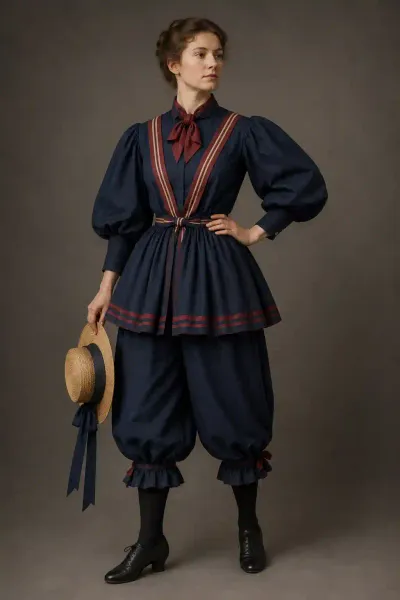
It's worth remembering that not everyone in this era was on board with corsets and crinolines - dress reformers were making health and practicality arguments against restrictive fashion well before it became a mainstream position.
The bloomer costume, covered in its own entry, is really the movement's first major public moment - Elizabeth Smith Miller's 1851 design, publicized by Amelia Bloomer, made a direct, practical argument against both the corset's health effects and the crinoline's sheer impracticality, and it was met with public ridicule severe enough that most of its original wearers, suffrage figures among them, quietly abandoned it in public within a few years rather than let the clothing fight distract from causes they cared about more. That early defeat didn't end dress reform thinking, though - it just pushed the argument to reassemble in a different, gentler register a few decades later.
The Aesthetic Dress movement of the 1870s and '80s, associated with figures like Constance Wilde and the broader Aesthetic and Pre-Raphaelite artistic circles, made essentially the same anti-corset, anti-crinoline argument the bloomer reformers had, but wrapped it in an aesthetic and artistic framing rather than an overtly medical or political one - loose, flowing, unstructured gowns inspired by medieval and classical dress, worn without rigid boning, marketed as beautiful and artistic rather than as a health intervention or a suffrage-adjacent statement. That reframing let it succeed, at least within its own limited circle, where the bloomer costume had failed publicly: it was never mainstream, but it drew real, sustained interest among an artistic and intellectual set without triggering the same scale of public mockery. Later in the century, the Rational Dress Society (founded 1881) picked the practical thread back up more directly, campaigning against tight-lacing and advocating for divided skirts for cycling and sport specifically - by then a more permissive climate, helped along by the genuine boom in women's cycling, let some of the movement's practical goals finally gain real, if still partial, ground. Taken together, I'd frame dress reform less as one failed campaign and more as the same underlying argument - that Victorian fashion was actively hurting women, physically and otherwise - resurfacing again and again across the century in whatever framing the moment would actually tolerate.