The Victorian Era First bustle phase (1870s)
Bustle Era, First Phase
The crinoline collapses toward the back of the body as the bustle emerges - skirts narrow at front, elaborately draped and trimmed behind.
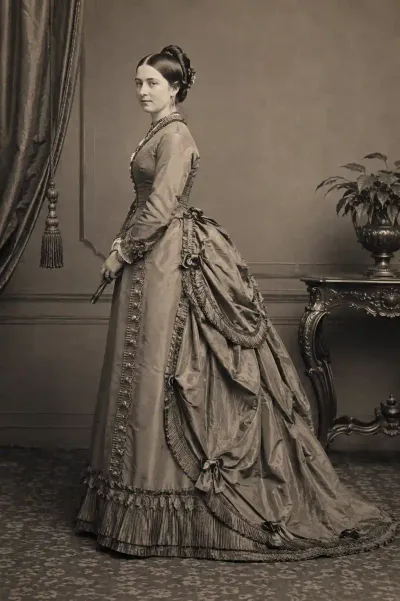
What strikes me about this shift is how fast it happens - within a few years the front of the skirt goes from bell-shaped to nearly flat, with all that volume and drapery pushed to the back instead.
The mechanics of that speed are worth spelling out, because the shift isn't really about a new idea replacing an old one - it's the same basic volume of fabric getting redistributed. Where the crinoline held a skirt out roughly equally in every direction, the first bustle takes that same fullness and pushes it backward and downward, so the front and sides of the skirt can go nearly flat against the body while everything else piles up behind in swags, poufs, and elaborate draped overskirts. The structure underneath is typically a half-cage or a simple horsehair or steel bustle pad tied at the back of the waist - much smaller and lighter than the full crinoline it replaces, even though the finished silhouette can look just as voluminous thanks to all that trim and drapery layered on top.
This is also the period where trained skirts and heavily worked, asymmetrical trimming reach a real peak - pleating, ruching, and fringe piled onto the back of a bodice and skirt in a way that reads, to modern eyes, as almost baroque. I find it useful to think of the first bustle as the crinoline's fullness reorganized around a single question - what happens if all that volume answers to gravity instead of sitting suspended around the body - and the trim is where dressmakers spent the energy the structure itself no longer required.
By decade's end this phase collapses almost as fast as it arrived, giving way to the slender natural form silhouette - a good reminder that "the bustle era" isn't one continuous look, but two genuinely distinct structural phases with a slim interlude in between.