The Victorian Era Victorian era, broadly
Corsetry and Boning
The construction techniques behind Victorian corsetry - boning materials, channeling, and lacing - that make every silhouette in the era possible.
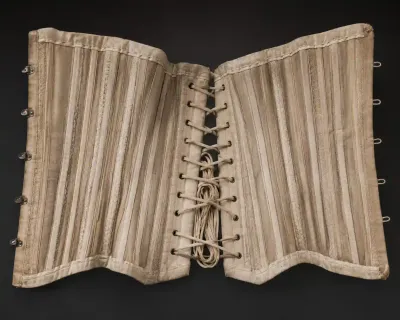
This is the era's construction story more than any other single topic. I want to get into real depth here on boning materials - whalebone giving way to steel - and how channeling and lacing actually work.
Boning material is the right place to start, because it changes meaningfully across the era and directly affects everything else about how a corset behaves. Early and mid-Victorian corsets rely heavily on baleen - commonly called whalebone, though it's actually the flexible keratin plates from a baleen whale's mouth, not bone at all - prized for a springy flexibility that steel doesn't quite match, but genuinely expensive and increasingly scarce as whaling pressure mounted through the century. Steel boning becomes more common from around mid-century onward, cheaper to produce at consistent quality once industrial steel manufacturing matured, and by the century's later decades steel had largely displaced baleen in mainstream corsetry, reserving whalebone mostly for premium construction. Each material is sewn into its own fabric channel - a narrow stitched casing running vertically (or, in later, more elaborate designs, following a slightly curved line) through the corset's layers, spaced closely enough around the torso that the whole garment moves as a coordinated structure rather than a collection of independent stiffened strips.
Lacing is the other half of the engineering, and it's worth being precise about what it actually does, because popular imagination tends to exaggerate it into pure torture. The back lacing (sometimes a front busk closure as well, for ease of dressing without help) allows the wearer to adjust overall circumference and, to a real but limited degree, redistribute where the body's soft tissue sits - compressing the waist somewhat while the boning channels the resulting shape smoothly rather than letting it bulge unpredictably. How tightly a corset was actually laced varied enormously by individual, occasion, and decade - extreme "tightlacing" was a real practice among a genuinely committed minority, but it was never the universal daily norm popular history sometimes implies, and most Victorian women's ordinary corseting was considerably less extreme than that image suggests. What doesn't vary is the underlying logic: boning material and channel placement do the actual shape-holding, and lacing does comparatively modest fine-tuning on top of a structure that's already doing most of the work - which is exactly why the specific silhouette a corset needed to produce shifted so much decade to decade, as covered separately in the corset entry, even while the fundamental boning-and-lacing construction method stayed recognizably the same the whole era through.