The Victorian Era Victorian era, broadly
Corset
The foundational structural garment of Victorian dress, shaping the torso to whatever silhouette a given sub-period demanded.
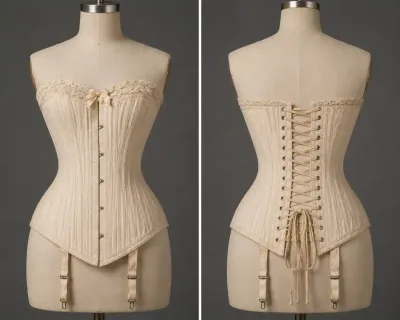
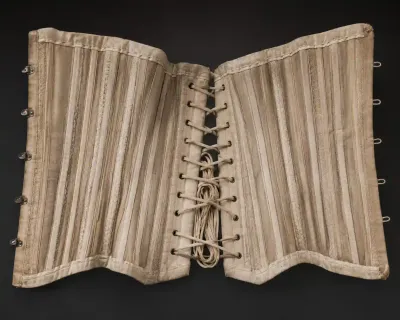
The corset is the one constant across the entire Victorian span. Silhouettes swing wildly from decade to decade, but there's a corset under almost all of them, cut differently each time. The corsetry and boning entry covers how they were built - busks, eyelets, baleen, steam moulding. This one follows the shape, because "corset" covers at least five quite different garments across Victoria's reign.
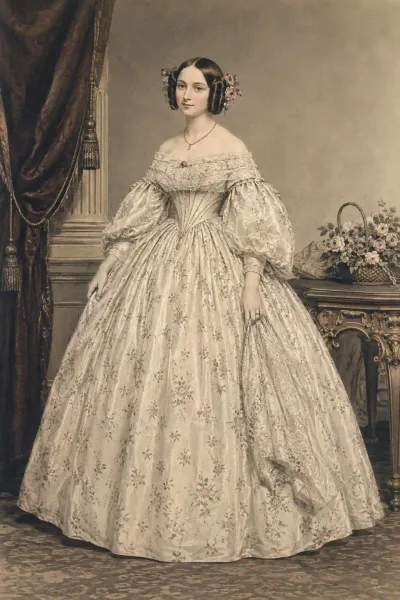
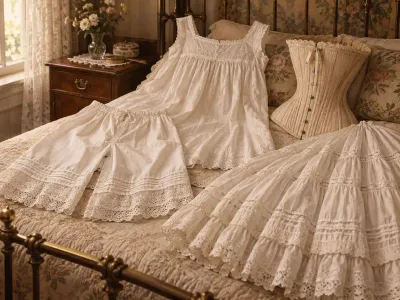
At the start of the reign it was a long, fairly gentle thing. The V&A has a white cotton corset of about 1835, shown with a linen shift and drawers of the same years, that is hand-sewn, only lightly boned, and stiffened mostly with cording. A long narrow pocket at the front held the busk, a flat piece of wood or ivory slid in to keep the front straight. Corsets of this period rounded the bust, held in the stomach and shaped the hips under the bell skirts of the early Victorian silhouette. They still had shoulder straps, set close to the edge of the shoulder so they wouldn't show under a wide, low evening neckline, and metal eyelets, new in the 1820s, let them be laced tighter than before.
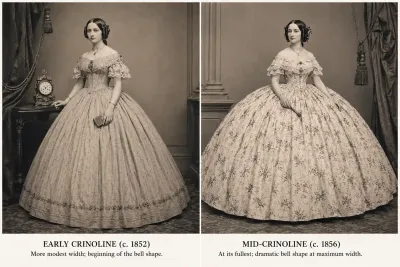
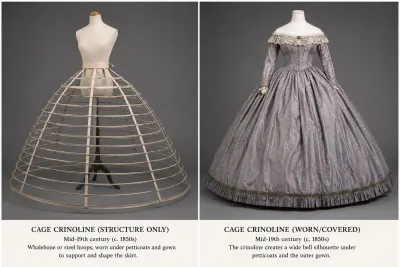
The crinoline era is where the popular image goes wrong. I used to assume the corset got more extreme under those huge skirts, but the V&A's view is the reverse. A wide cage crinoline made any waist look small by contrast, so tight lacing became less pronounced and corsets grew fuller over the hips. The waistline rose, the shoulder straps were dropped, and the split front busk with its loops and studs became standard. Sewing machines let makers offer far more variety, much of it in bright silks, to women with less money. A red silk corset of about 1860, trimmed with broderie anglaise, is a good example - hardly the grim white object most people picture.
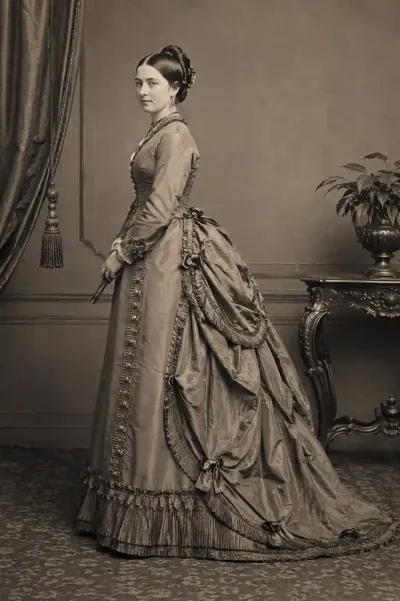
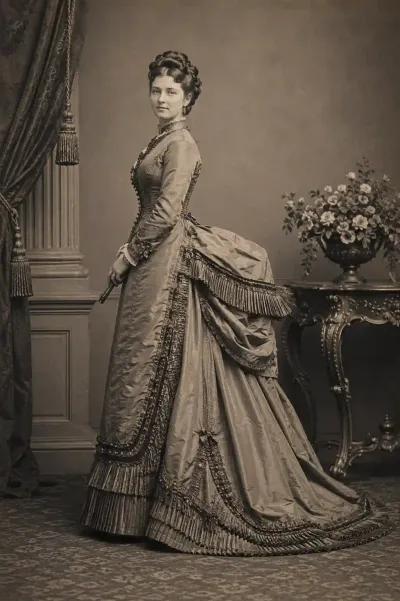
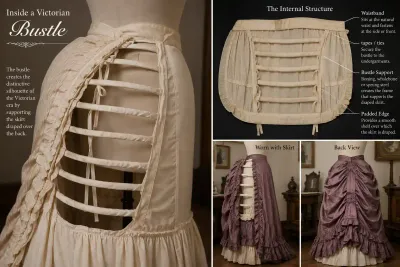
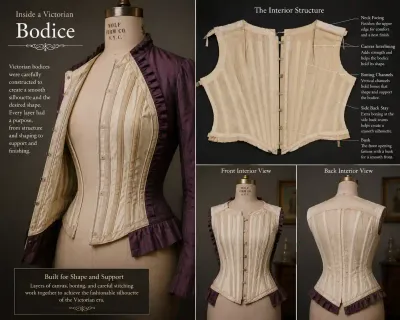
The bustle decades brought the longest corsets. When skirts narrowed in the early 1870s, corsets lengthened to give a slender line and had to be rigid enough to hide the chemise and petticoat underneath, especially under the long, close-fitting bodices of the natural form years. Lacing got tighter, the hourglass more pronounced, and the number of whalebone strips went up. A red corset of 1883 at the V&A shows the period's two signatures: its whalebone is covered in beige leather, an 1880s fashion, and it closes on a "spoon" busk that widens at the bottom. That shape was meant to spread pressure over the stomach, but as the museum notes, it actually let the waist be pulled in harder.
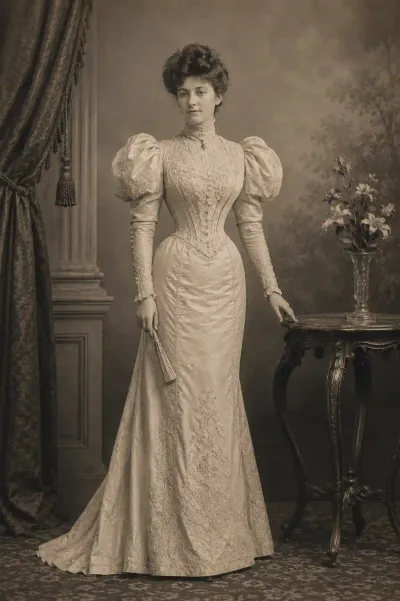
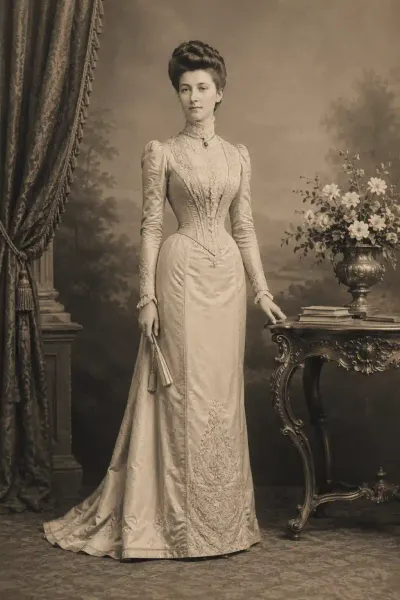
By the 1890s the corset was sculpting a long, smooth hourglass under the Gibson Girl's big sleeves and plain skirts. A pink satin corset of 1890-95, trimmed with black bobbin lace, is built from five shaped pieces on each side plus bust and hip gussets. It's short at the hip and dips to a point over the stomach, with a straight busk that makes one vertical line from bust to abdomen and a small hook to stop the petticoat riding up at the waist. The straight-fronted corset that pushed the body into the S-bend came in only around 1897, and the S shape was dominant by 1900.
The same decade made reformed corsets a fashion in their own right. Around the 1890s, the V&A says, reformers' long campaign began to reach the mainstream: ribbon corsets, ventilated corsets of Aertex cotton, and a plain quilted cotton one stamped "RATIONAL Style 444" with a picture of a woman holding up a baby, a nod to reformers' fears that fashionable corsetry endangered motherhood. A girl's corset of unbleached wool, labelled Jaeger, from about 1890, has shoulder straps and is stiffened with cords and tapes rather than bones, apart from the front and back. Put it next to the corset of 1835 and the century has come almost full circle. The real break came later, with the elastic roll-on of the 1930s.
Sources
- "Corsets, crinolines and bustles: fashionable Victorian underwear" - Victoria and Albert Museum
- Corset, cotton stiffened with cording and whalebone, England, ca. 1835 - V&A Collections
- Corset, red silk with broderie anglaise trim, England, ca. 1860 - V&A Collections
- Corset with spoon busk and leather-covered whalebone, England, 1883 - V&A Collections
- Corset of satin with hand-made bobbin lace, England, 1890-1895 - V&A Collections
- '"RATIONAL" Style 444', corset of white cotton, Great Britain, ca. 1881-1901 (T.236-1989) - V&A Collections
- Girl's corset of unbleached wool, Jaeger, England, ca. 1890 - V&A Collections
- Fashion History Timeline, "1890-1899" - Fashion Institute of Technology