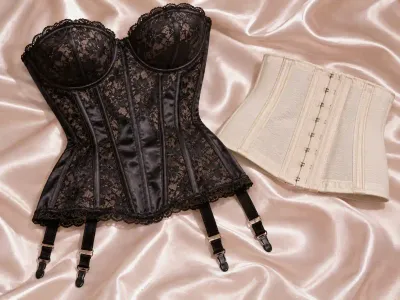
The 1950s 1950s
Boning for Strapless and Halter Eveningwear
Internal boning built into a strapless or halter bodice to keep it up and shaped without any shoulder support at all - a real engineering problem eveningwear had to solve.
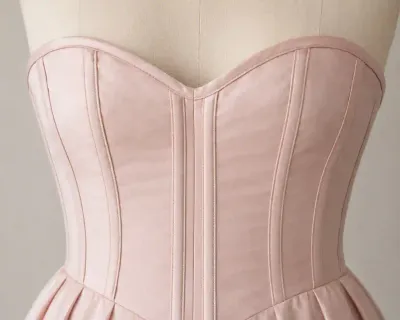
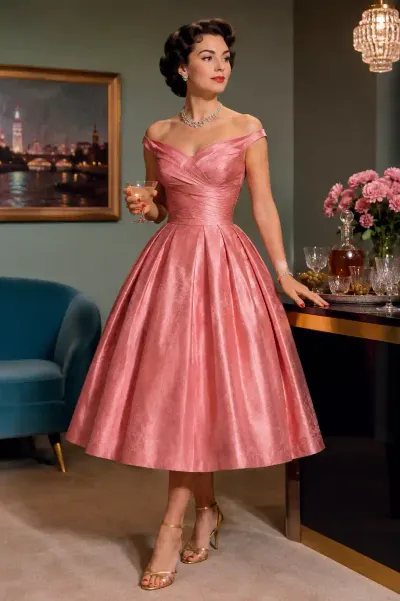
A strapless gown has a problem the boned bodices of fitted day dresses never quite face: there is nothing at the shoulder to hang it from. The 1930s backless gown had faced a version of the same problem with cutting alone. Everything depends on the fit, the boning, and the grip at the waist. Strapless bodices were still fairly new in the 1950s, and they suited the decade's proportions so well - a bare, simple top over a big skirt - that a great many of its cocktail dresses and ball gowns went without straps entirely.
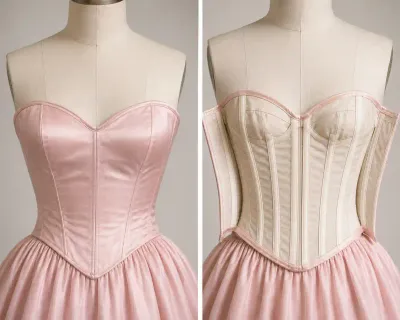
The answer couture settled on was to build a corset into the dress itself. Turn a 1950s couture strapless dress inside out and you usually find a second, hidden bodice. Dior's Y-line cocktail dress from autumn/winter 1955, now in the V&A, has a stitched-in internal corset of nylon mesh with boning, bust pads and its own hook-and-eye fastening, done up separately before the zip of the dress. Pierre Balmain's "Brocéliante" of 1954, which Lilli Palmer wore in the 1956 film Teufel in Seide, sits on a white cotton net corset that even carries suspenders for stockings, and the satin slip under the skirt is attached to the outside of that corset at the waist. The fashion fabric hardly does any structural work. It is mounted over the foundation, which is why these dresses can look so effortless from the front.
The bones themselves had moved a long way from the whalebone of the Victorian corset. A Dior cocktail dress made in 1952-4 by C. D. Models (London) Ltd, the house's London ready-to-wear company, has a tacked-in waist corset of two layers of net with eight flat plastic bones. Plastic is light and cheap but bends in only one direction, so it suits straight channels at the side seams and centre back. Spiral steel, a flattened coil of wire, bends sideways as well and follows a seam curving over the bust and ribs much better, and it appears as "metal coil" boning in the underbodice of Dior's 1955 "Écarlate". Foundations of nylon mesh or cotton net kept the whole inner bodice thin, so it could disappear under a slim sheath as well as under a ball skirt.
The other half of the engineering is at the waist. A Hardy Amies evening dress of 1953 in the V&A has a crêpe-backed satin foundation, boned at the bodice, with "a firm waist-stay attached", and both the Balmain and a late-1950s Victor Stiebel gown have white grosgrain waistbands inside. A waist stay is a strip of grosgrain or petersham cut to the wearer's exact waist measurement and hooked shut before the dress is zipped. It anchors the bodice at the narrowest point of the body so it can't slide down, and it takes the weight of a full skirt and its petticoats off the zip and the boning. If you are making one of these dresses today, cut the stay snug - it is doing more of the holding-up than the bones are.
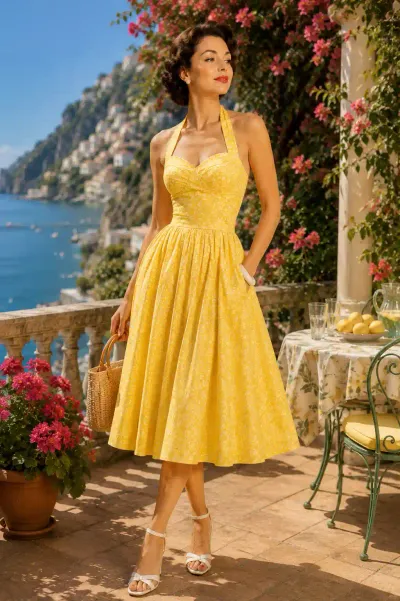
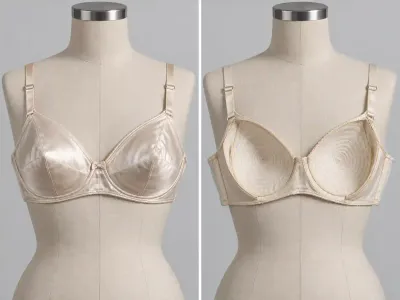
The Stiebel dress also shows how separate the straps were from the structure. Lady Templer bought it as the original house model, strapless, then asked Stiebel to add straps because her shoulders were narrow - an easy alteration, because the dress never depended on them. A halter neckline works the same way: it takes a little of the load up to the back of the neck, but on an evening dress it is often there mostly for the line, and the boned foundation underneath still does the gripping. The daytime halter sundress is the lighter cousin. Women who wanted the same effect from a dress with no built-in corset could buy it separately, which is what Warner's Merry Widow was. The method never went away, either: the 1980s prom dress is built on the same boned inner bodice.
Sources
- Cocktail dress, Christian Dior, 'Y' line, autumn/winter 1955 (T.4-2020) - V&A Collections
- Evening dress 'Brocéliante', Pierre Balmain, 1954 - V&A Collections
- Cocktail dress, Christian Dior London (C. D. Models (London) Ltd), 1952-4 - V&A Collections
- Evening dress, Hardy Amies, 1953 - V&A Collections
- Evening dress, Victor Stiebel, late 1950s - V&A Collections