The 1980s mid-to-late 1980s
Boned Strapless Bodice Construction
Vertical rigid supports sewn into a fitted, strapless bodice lining - the internal structure that lets a garment with no straps at all stay put through an entire evening of dancing.
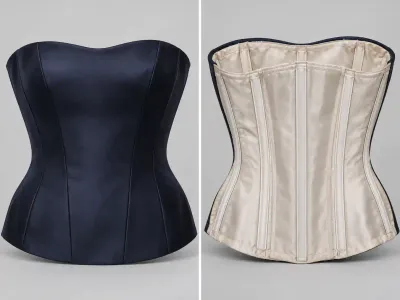
A strapless bodice has to solve a real physical problem that a garment with straps doesn't: without anything anchored at the shoulder, the whole top has to stay in place purely through how closely and rigidly it's built around the torso. Boning - originally whalebone, by this era almost always plastic or spring-steel strips - gets sewn vertically into channels inside the bodice's lining, spaced around the torso to hold the fitted shape firm and prevent the fabric from folding, slipping, or rolling down over the course of a long evening.
This is, in a real sense, a direct descendant of corsetry's underlying engineering logic, though considerably lighter and far less restrictive than a Victorian corset's boning ever was - the goal here is keeping one fitted panel in place rather than reshaping the torso's actual silhouette underneath it. Combined with a snug, often internally elasticized fit at the top edge, the boning does most of the practical work that lets the decade's prom silhouette stay convincingly strapless through hours of dancing rather than needing constant adjustment.
The heavier, more structured fabrics this construction typically pairs with - taffeta built up over layered tulle, finished in sequins or lamé - actually help the boning do its job, since a stiffer outer fabric holds the boned shape more cleanly than a soft, fluid one would. I think this construction detail is worth real attention specifically because it's invisible when it's working - nobody looking at a strapless prom dress is admiring the boning inside it, but take that structure out and the whole garment simply doesn't function as intended for more than a few minutes.