The 1980s late 1980s
Taffeta and Tulle
A crisp, structured woven silk or synthetic and a fine, stiff netting - paired together to give the decade's eveningwear skirts the volume and rustle no soft, draping fabric could deliver alone.
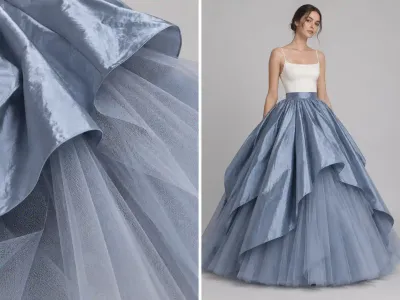
Taffeta is a tightly woven fabric, historically silk but frequently synthetic by this decade, with enough natural crispness to hold a defined shape and produce an audible rustle with movement - qualities a soft, fluid fabric like jersey or chiffon simply can't offer. Tulle is a fine, stiff netting, typically nylon, used less as a visible outer layer and more as bulk-building underlayers, stacked in multiple tiers beneath a taffeta or satin skirt to push its volume out far beyond what the outer fabric alone could support.
Paired together, they're the structural backbone of the decade's prom silhouette - a fitted, often boned strapless bodice giving way to a skirt built from taffeta over layered tulle, wide and stiff enough to hold its shape through an entire evening of dancing without collapsing or clinging to the body underneath it. That's a genuinely different silhouette logic than the decade's aerobics or power dressing stories, both of which lean on fabric that moves closely with the body rather than holding independent structure away from it.
Christian Lacroix's 1987 "le pouf" collection is the couture-level showcase for exactly this fabric pairing, and its influence trickled down into prom and eveningwear racks fast enough that the combination became close to a default by decade's end. I think taffeta and tulle together tell a useful structural story: sometimes achieving real volume has less to do with clever pattern-cutting and more to do with simply stacking the right stiff, bulky materials underneath a crisp outer layer until it holds the shape you actually want.