The 1980s late 1980s
The Leg-of-Mutton Sleeve Revival
A sleeve cut full and puffed at the shoulder, narrowing sharply at the elbow to a fitted forearm - a Victorian-era shape brought back for a completely different eveningwear moment a century later.
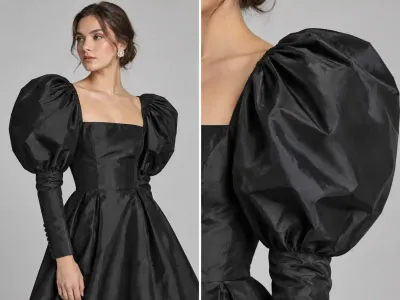
The leg-of-mutton sleeve is named, like the A-line decades before it, for the shape it traces - full and rounded at the shoulder, narrowing sharply somewhere around the elbow to a close-fitted lower arm, the whole silhouette resembling a leg of mutton hanging from a hook. It's a genuinely old technique, most associated with the 1890s Gibson Girl era's dramatic sleeve volume, and this decade's revival borrows the shape wholesale rather than reinventing it, adapting it for a completely different eveningwear context roughly a century later.
Achieving the shoulder's puff convincingly takes real construction control: the fabric is gathered densely at the top of the sleeve cap, often supported by an internal structure of stiff interfacing or a light boning to hold the puff's shape rather than letting it collapse under its own fabric weight, before narrowing abruptly to a fitted seam at the elbow. That's a meaningfully different technical problem than the decade's batwing sleeve construction, which achieves its own volume through loose, unstructured draping rather than deliberately shaped and supported gathering.
Christian Lacroix's 1987 couture debut leaned on exactly this kind of dramatic, structured sleeve volume alongside his signature puffed skirt, and the combination shows up constantly in the prom silhouette closing out the decade, frequently built from the same taffeta doing the skirt's structural work. I think this revival is a good reminder that this decade's maximalism wasn't purely a new invention - a fair amount of it is genuinely old construction technique, borrowed deliberately from a much earlier era and redeployed at a completely different cultural moment.