The 1980s early 1980s
Batwing and Dolman Sleeve Draping
A sleeve cut in one continuous piece with the bodice, widening dramatically from wrist to underarm - a way to build huge visual volume into an arm without adding real weight or restricting movement.
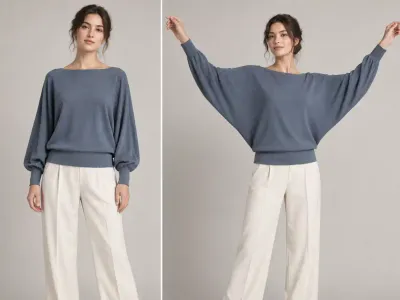
A batwing or dolman sleeve is cut as one continuous piece with the garment's bodice rather than set in separately at a defined armhole seam - the fabric widens gradually from a fitted wrist or cuff all the way up to the underarm, where it joins the body of the garment in a deep, sweeping curve rather than a tight seam. The construction logic is genuinely different from a conventional set-in sleeve: instead of shaping fabric around the arm's actual circumference, it drapes loosely away from the arm entirely, held up mostly by the wearer's own posture rather than by close fitting.
That looseness is exactly what makes it useful for the New Romantic silhouette's theatrical volume - a sleeve this shape reads as dramatically large on camera or under stage lighting while adding almost no actual weight to the garment and placing no real restriction on arm movement, since there's no tight armhole seam to work against. A performer needs to be able to move freely on stage while still projecting visual scale from the audience or from a television camera, and this cut solves both problems at once in a way a fitted, tailored sleeve simply couldn't.
I think this construction technique is worth separating out on its own because it's a genuinely old idea - dolman sleeves go back centuries in various forms - being redeployed for a very specific new purpose: dressing for a small screen rather than a live room. A New Romantic performer's ruffled shirt needed to read as visually enormous in a three-minute music video, and building that scale into the sleeve's cut rather than into separate padding or structure kept the whole garment light enough to actually perform in.