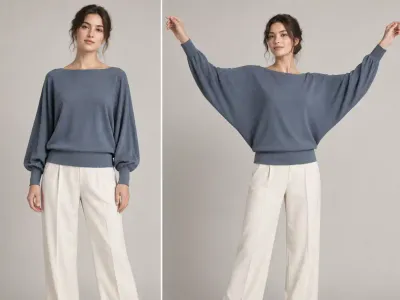
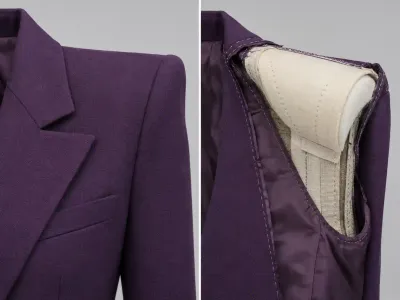
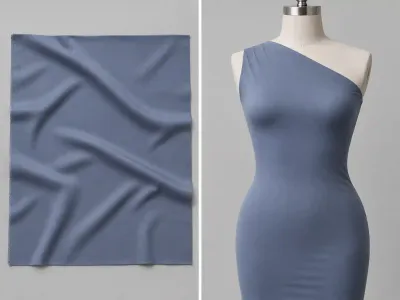
The 1980s mid-to-late 1980s
Azzedine Alaïa
Nicknamed 'the King of Cling' - a Tunisian-French designer whose precisely engineered stretch-knit dresses proved body-conscious construction could be sophisticated rather than merely athletic.
"The King of Cling" is what the fashion press called Azzedine Alaïa in the 1980s, and it undersells him, because cling is easy and what he did was not. He trained as a sculptor at the École des Beaux-Arts in Tunis, came to Paris in 1957, lasted a matter of days at Dior, and then spent the better part of two decades working privately - dressmaking in aristocratic households and for clients who included Greta Garbo and the actress Arletty - before launching a ready-to-wear line at the turn of the decade (accounts give 1980 or 1981). New York followed in 1982, and in 1985 the French Ministry of Culture named him designer of the year. His mid-decade fame came with twenty-odd years of fittings behind it.
Where most of this decade's stretch construction shows up in leotards and gym gear, Alaïa treated knit as a tailoring material. He did his own cutting, fitted directly on the body, and built garments from many small pieces - some, according to Caroline Cox's entry in Contemporary Fashion, from as many as forty - joined with crisscrossing seams and stitches borrowed from corsetry. Pieces he gave the V&A in 1985 show how. A knee-length dress in heavyweight machine-knitted viscose looks plain from the front, but its back is a complex structure of shaped panels, buttoned closed. A green bodysuit worn with skintight trousers has padded shoulders, and it fastens beneath the crotch so it stays taut and can't ride up. What surprised me in the records is the fibre: those 1985 knits are catalogued as viscose or acetate, with no elastane listed. The grip came from the knit and the seaming. In the Met's Alaïa records, spandex only starts to appear in the fibre lists around 1990, in dresses like one from autumn/winter 1990-91 in wool, nylon and spandex, so I wouldn't assume Lycra was doing the work in his early pieces.
The zip was his other structural tool. The V&A's denim dress of about 1983 has a diagonal, double-ended brass zip that opens the entire front, more zips on the pockets, and curved welted seams that the catalogue says "ensure firmness of fit" - along with exaggerated shoulder pads and batwing sleeves, so he was not immune to the decade's big shoulder. The Museum at FIT's "Mermaid" dress from winter 1986 goes further: a hooded sheath in green acetate knit with a moiré effect, a cowl neck, large shoulder pads, and a zip set into a curved seam that spirals around the body down to a fishtail hem. That zip is doing the job boning does in a bodice, controlling the fit exactly, and it is the decoration as well. It has come a long way from the side placket where the zip first settled into dressmaking.
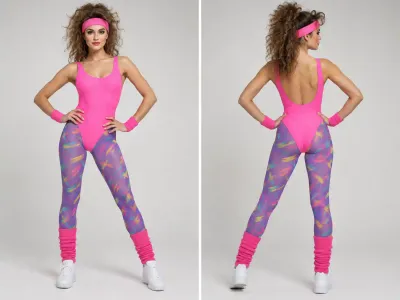
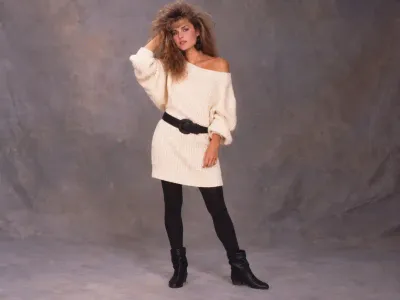
Cox connects his success to the fitness boom: women who had taken up exercise wanted to show a toned body, and the high street copied him with the stretch mini, Lycra cycling shorts and the bodysuit. That puts him on the bridge between the gym-to-street aerobics silhouette and high-fashion body-consciousness, and the close-fitting knit sweater dress is where the two meet. She also points to his debt to Madeleine Vionnet, who brought lingerie techniques to outerwear and cut crêpe to mould the body. Among his Paris contemporaries, Gaultier put the corset on the outside as a joke you were in on, and Mugler built armour, while Alaïa hid the foundation work inside the dress itself.
He also stayed out of the seasonal Paris show calendar, showing privately on his own schedule, which is a very dressmaker's way to run a house. The body-conscious line he drew runs straight into the next decade, where Hervé Léger's bandage dress took the idea of a dress built up from strips of elastic knit and made it the going-out uniform of the supermodel years.
Sources
- Ensemble (bodysuit, trousers and belt), Azzedine Alaïa, 1985 - V&A Collections
- Dress, machine-knitted viscose, Azzedine Alaïa, 1985 - V&A Collections
- Dress, cotton denim and brass zippers, Azzedine Alaïa, ca. 1983 - V&A Collections
- "Mermaid" evening dress, Azzedine Alaïa, Winter 1986 - The Museum at FIT
- Dress, Azzedine Alaïa, fall/winter 1990-91 - The Metropolitan Museum of Art
- Caroline Cox, "Alaïa, Azzedine" - Contemporary Fashion, via Encyclopedia.com
- "Tunisian-born 'king of cling' Azzedine Alaia dies at 77" - Associated Press, via Arab News, 2017