The 1980s mid-to-late 1980s
The Power Silhouette
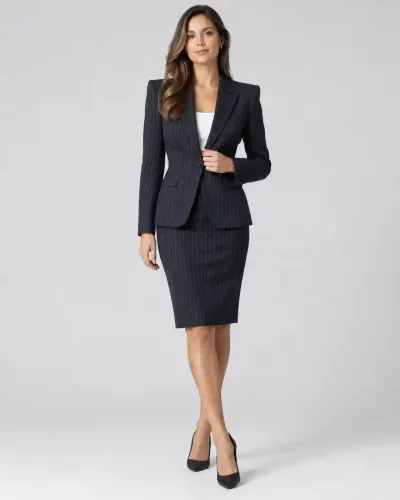
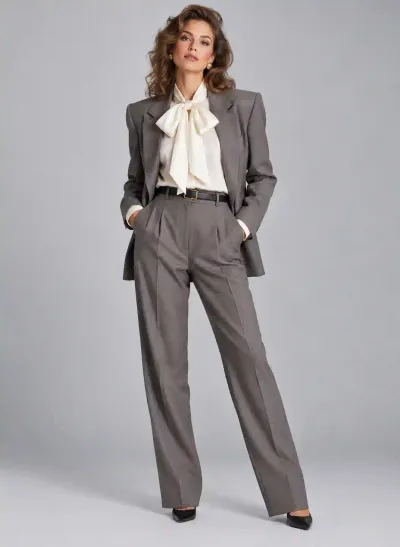
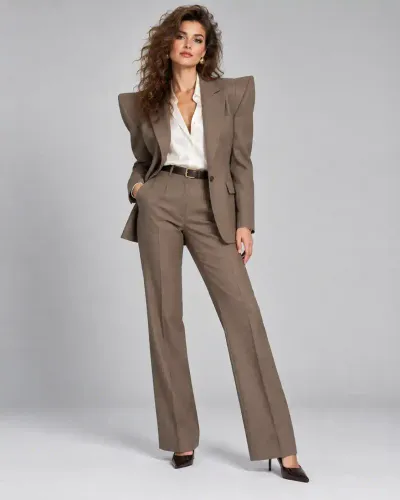
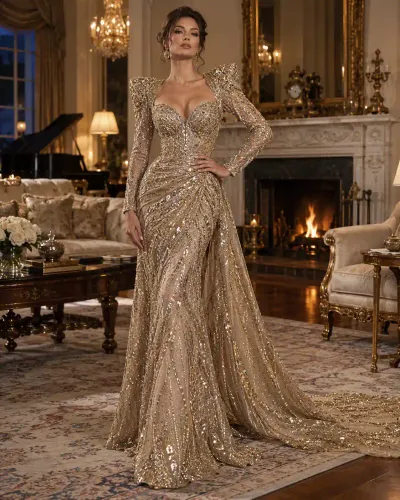
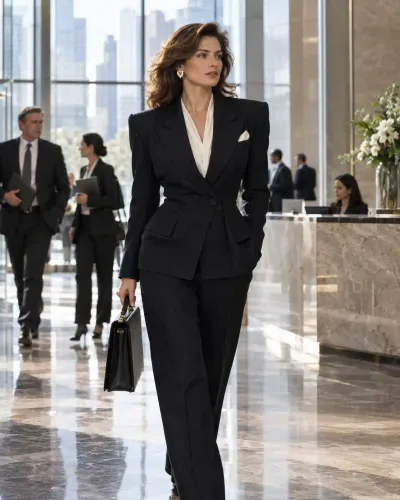
Padded shoulders, a nipped waist, and a hemline that stops at the knee - the shape a generation of women reached for to look unmissable in rooms men had run alone until recently.
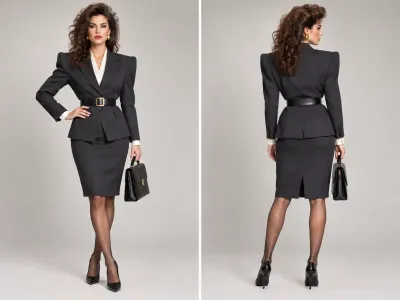
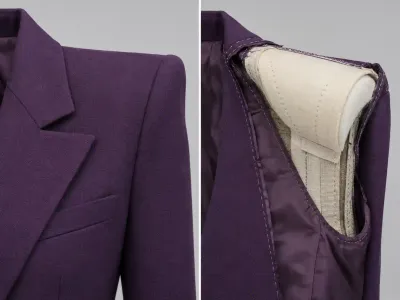
The power silhouette answers a question a lot of women were asking in the 1980s: what do you wear to a meeting where you're the only person in the room not in a suit that has been signalling authority for a century? The decade's answer is an inverted triangle - shoulders built out well past the body's own, a narrower waist, and a straight, knee-length skirt or a trouser underneath. It borrows from men's tailoring, but it was never a copy of the man's suit. The skirt, the shorter jacket and the fitted middle kept it a woman's shape. Who wore it and why belongs to the entry on power dressing and corporate feminism; this one is about the shape.
It wasn't new, and the designers knew that. The Museum at FIT says that when Donna Karan launched her own label in 1985 she drew on the broad-shouldered, narrow-hipped silhouette of the 1940s, and you can follow that line back through the wartime square shoulder to the broad-shouldered 1930s. What the 1980s changed was the body the shape was meant to suggest. FIT reads the bold proportions of a Karan jacket from autumn 1986 as implying an athletic physique, the kind built in a gym. The 1940s shoulder said capable and thrifty; the 1980s one said strong.
The range inside the shape was enormous. At one end, the Kyoto Costume Institute holds three Thierry Mugler jackets from autumn/winter 1988 to spring/summer 1990 that use thick pads to exaggerate the height of the shoulder as well as its width - one in yellow polyester-triacetate with a zigzag-cut hem, another patchworked from eight colours of wool gabardine. In Paris couture, the V&A's two suits by Helene Hayes, made in her atelier for clients including Mrs Rupert Murdoch and Mrs Henry Ford, have large shoulders and asymmetric details, and the museum uses them to illustrate "so-called power dressing". Azzedine Alaïa's version at FIT, a black cotton twill suit of about 1985, takes the waist further than most: a double-breasted jacket gathered into a fitted waist over a peplum, and a closely fitted straight skirt with a pleat at the back hem.
The nipped waist, though, was optional, and that's the thing I'd most want a dressmaker to notice. Margaret Thatcher's "Sapphire Blue" suit, an off-the-peg Aquascutum model she wore to the 1987 Conservative Party conference, has shoulder pads and a matching pencil skirt, but the V&A describes the jacket as cut relatively straight with only slight shaping at the waist. Its own measurements bear that out: 100 cm around the bust, 96 cm around the jacket waist. That's almost a box. What made it read as a power suit was the shoulder and the hem, not the waist.
Karan's 1986 jacket shows the opposite way to get there. It isn't tailored at all - it's a navy wool jersey wrap tunic, draped at the front waist and closed with a tie sash, with squared, padded shoulders and sleeves tapering to the wrist, the kind of piece Karan layered over a bodysuit rather than a blouse. Soft cloth and no tailoring, and still the same outline, because the pads were carrying it. That's why the shoulder-pad blazer and the pads themselves have their own entries: the silhouette was really a shoulder line that could be attached to almost anything. When the next decade wanted a different idea of authority, the shoulder was the first thing to go - the unstructured jacket of the 1990s is this shape with the pads taken out.
Sources
- Jackets, Thierry Mugler, autumn/winter 1988, spring/summer 1990 and late 1980s - The Kyoto Costume Institute, via Google Arts & Culture
- Jacket, Donna Karan, fall 1986 (2000.32.8) - The Museum at FIT
- Suit, Azzedine Alaïa, c. 1985 (2013.85.16) - The Museum at FIT
- Skirt suit, red and black checked wool, Helene Hayes, 1988 - V&A Collections
- Skirt suit, charcoal wool with black velvet trim, Helene Hayes - V&A Collections
- 'Sapphire Blue' suit, Aquascutum (designed by Margaret King), early 1987, worn by Margaret Thatcher - V&A Collections