The 1990s throughout the 1990s
Jil Sander
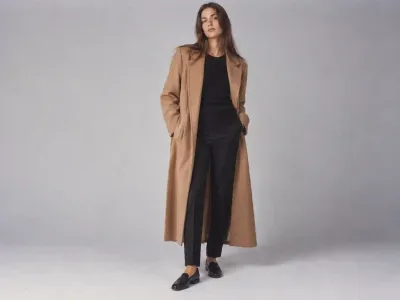
The Hamburg designer the press called the 'Queen of Less' - exact tailoring in her own wool-silk and linen-silk blends, shown in Milan - whose label defined 1990s minimalism until she left it in 2000, months after Prada bought control.
If Calvin Klein made minimalism American and Helmut Lang made it edgy, Jil Sander made it exact. The press called her the "Queen of Less", and also, more usefully for a dressmaker, the "Cashmere Queen". Her clothes look like almost nothing in a photograph. Their whole case is made in the hand and on the body.
She came to fashion through cloth. Born Heidemarie Jiline Sander in Wesselburen, in north Germany, on 27 November 1943, she graduated from the textile school at Krefeld in 1963 and worked as a fashion journalist before opening her first boutique in Hamburg - in 1967, according to The Business of Fashion, or 1968, the year usually given for the founding of the label. Her first women's collection followed in 1973, and her first Paris showing, in 1975, was not a success. She built the business anyway: cosmetics and fragrance from 1979, and in 1989 a public listing in which, Britannica notes, she kept all the voting shares and so kept creative control.
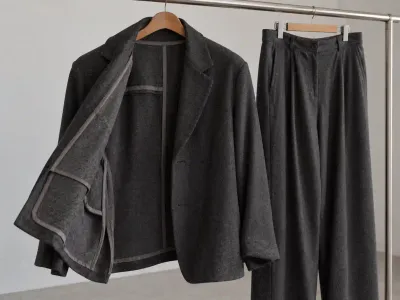
By the 1990s the minimalist mood had caught up with her. Britannica describes work that depended on "exceptionally sophisticated fabrics, precise three-dimensional construction, proportion, tailoring", and on the tension between austerity and sensuality. Contemporary Fashion adds the practical detail: menswear-derived cloths, often her own blends of wool and silk or linen and silk, in pale neutrals. Those blends matter. Silk makes wool lighter and smoother, with a slight sheen, and helps a jacket fall from the shoulder rather than sit on it like 1980s armour. Interviewed by Mirabella in 1991, when her women's suits cost between $1,500 and $6,500, she was unapologetic: "If you want quality, it costs." What surprises me is that she didn't think of herself as a classicist. "I find 'timeless' classic terribly boring," she told German Vogue in January 1990. "A classic is an excuse, because one is too lazy to confront the spirit of the time."
The clothes were made in Italy and shown in Milan - for almost a decade, by Contemporary Fashion's count, though sources disagree on exactly when the Milan shows began - and in January 1997 she took her first menswear collection there too. Her late-1990s collections moved more than the "minimal" label suggests. Contemporary Fashion describes a drapey 1998 of rayons and metallic threads, then a tougher 1999 of vinyl tunics, ruching and pintucking, felted and rubber-coated wools, and fabrics turned over to show their faded underside. That last trick is one I love: the wrong side of a cloth is often softer and quieter than the face, and using it means planning every seam so that nothing of the right side shows. The Met's suit from autumn/winter 1998-99 is catalogued simply as wool and cotton, which seems right for her - the description is as plain as the clothes.
In 1999 Prada bought 75 per cent of the company, part of the same spree that took it into Helmut Lang and Gucci, as the Miuccia Prada entry describes. Sander saw the deal as a partnership. Five months later, in January 2000, she was gone. Contemporary Fashion puts the break down to Patrizio Bertelli's refusal to budget for the fine fabrics and trims of her $3,000 suits, and quotes him saying that "a brand that's as strong as Jil Sander doesn't need to rely on the name of a designer." Her collection for spring 2000, shown the autumn before she left, was by Vogue's account lighter and more feminine than usual, with florals, western shirts, gathered waistbands and lacy chiffons in black and white with flashes of rose and yellow. She came back in 2003-04 and again in 2012-13, and in 2017 Frankfurt's Museum Angewandte Kunst gave her a first solo exhibition. Its summary of her principles - "harmony of proportion, sophisticated three-dimensionality, understatement and dynamic elegance" - would do as a definition of good dressmaking.
Sources
- Rachel Cole and the Editors, "Jil Sander" - Encyclopaedia Britannica
- Valerie Steele, updated by Mary Ellen Snodgrass, "Sander, Jil" - Contemporary Fashion, via Encyclopedia.com
- "Jil Sander" - The Business of Fashion, BoF 500
- "Jil Sander. Present Tense" (exhibition, 2017-18) - Museum Angewandte Kunst, Frankfurt
- Suit, wool and cotton, Jil Sander, fall/winter 1998-99 (2001.786a, b) - The Metropolitan Museum of Art
- Jil Sander, Spring 2000 Ready-to-Wear - Vogue Runway
- Neslihan Degerli, "#TBT: Jil Sander as 'The Queen of Less'" - Title Magazine, 13 October 2020