The 1990s throughout the 1990s
Calvin Klein
The New York designer who gave 1990s minimalism its American form - tricotine suits, nude jersey and slip dresses for women - and whose underwear, fragrance and jeans advertising set the decade's image of the body, and its arguments.
Calvin Klein had been in business since 1968, when he and his childhood friend Barry Schwartz set up the company, and he has already turned up on this site designing printed cheesecloth pyjamas in 1971 and tight, nearly straight designer jeans at the end of that decade. But the 1990s were his. More than any other American, he decided what minimalism looked like on a woman, and his advertising decided, for better and worse, what the woman inside the clothes was supposed to look like.
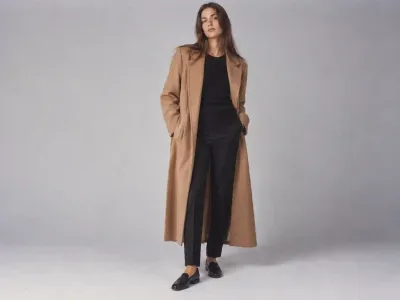
He described his aim to Women's Wear Daily as "modern, sophisticated, sexy, clean, and minimal," and a 1994 press statement put it more briefly: "Everything begins with the cut." The V&A, to which Klein gave a run of his clothes in 1997, shows what that meant early in the decade. A 1992 skirt suit pairs a single-breasted jacket with a stand-up collar and a straight skirt to mid-calf, both in what the museum calls "clay cavalry tricotine" - a firm worsted twill with a doubled diagonal rib. That choice does a lot of the work. A cloth that dense holds a crisp edge with very little interfacing, so the jacket can be stripped of detail and still look sharp, and a narrow skirt that long in that weight needs a vent or a pleat to walk in. It's the power suit with everything taken off.
By spring 1994 even the tailoring had softened. Vogue describes that collection as pale and "lingerie-layered", a run of slip dresses that sounded "the final death knell" for the dress-for-success woman. "Nothing is stiff," Klein said, and the nineties, he told the magazine, were "about the personal, about staying in and being alone, and not flaunting what you have on your back." The slip dress entry follows his FIT examples; a plainer relation is the long tank dress of nude matte jersey from 1996, one of several pieces in the same flesh colour that he gave the V&A. Nude jersey hides nothing. Every seam allowance shadows through, so a dress that simple has to be cut and sewn perfectly, which was the real luxury.
The other half of the business was underwear, and that's where the image came from. In 1992 Herb Ritts photographed Kate Moss, then 18, with Mark Wahlberg, still the rapper Marky Mark, for a campaign that Interview says made Klein's underwear business grow "exponentially". Moss has since said she had a nervous breakdown around that time and that the shoot didn't feel like her. The women's line used the same signature trick as the men's: the V&A's spring/summer 1994 bra top and knickers, collected for its Streetstyle exhibition, are black Lycra sports shapes with wide elastic waistbands carrying his name - the band that the oversizing entry shows rising above low-slung jeans. Then came Moss's Obsession pictures and the "heroin chic" criticism that the waif silhouette entry deals with. CK One, launched in 1994 as one fragrance for men and women, carried the same androgynous mood onto every drugstore counter.
The most serious controversy came in summer 1995. A cK Jeans campaign that began in early July, in magazines, on television and on New York buses, showed young models half-dressed in sexually suggestive poses. Parents, retailers and child-welfare groups protested, the American Family Association asked Attorney General Janet Reno to investigate, and the FBI opened an inquiry; the models' agency said all four were well over 18. Klein ended the campaign on 28 August 1995, saying it had been misunderstood, and later reference accounts say the Justice Department concluded the pictures were not pornography. The company was less secure than it looked. It had been reorganised in 1992 with help from David Geffen, and by the mid-1990s Klein had sold the jeans and underwear businesses to Warnaco. The famous pictures were selling licensed goods; the collection, where the minimalism actually lived, was still his own.
Sources
- "Calvin Klein" - reference entries, Encyclopedia.com
- Calvin Klein Collection, Spring 1994 Ready-to-Wear - Vogue Runway
- Skirt suit, clay cavalry tricotine, Calvin Klein, 1992 (T.243:1, 2-1997) - V&A Collections
- Dress, nude matte jersey, Calvin Klein, 1996 (T.250-1997) - V&A Collections
- Bra top, black Lycra and elastic, Calvin Klein, spring/summer 1994 (T.278-1994) - V&A Collections
- Trey Taylor, "Obvious History: Kate Moss and Marky Mark Couldn't Stand Each Other" - Interview Magazine, 15 March 2018
- "FBI investigates Klein over 'kiddie porn' advertising allegations" - Reporters Committee for Freedom of the Press, 25 September 1995