The 1990s early 1990s
The Supermodel Era
Linda, Naomi, Christy, Cindy, Tatjana and Claudia - the handful of models who became global celebrities in the early 1990s, launched by a 1990 Vogue cover and a George Michael video, before the waif and the actress-cover took over.
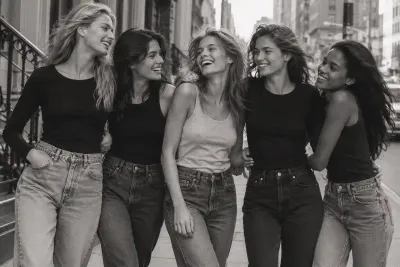
Fashion models had been famous before - think of Twiggy in the 1960s - but in the early 1990s a small group of them became something new: global celebrities, as famous as film or pop stars, known by their first names alone. It's one of the most important cultural stories of the decade, and it shaped how fashion was sold.
The group is usually defined by a few names: Linda Evangelista, Naomi Campbell, Christy Turlington, Cindy Crawford, and Tatjana Patitz, with Claudia Schiffer, Helena Christensen, Stephanie Seymour, and others often counted among them too. Their rise was built on several famous images. In January 1990, the photographer Peter Lindbergh shot five of them - Evangelista, Campbell, Turlington, Crawford, and Patitz - together, in simple, pared-back casual clothes on a New York street, for the cover of British Vogue - a follow-up to his famous 1988 photograph of models in white shirts on a Santa Monica beach. George Michael saw it and cast them in his music video for "Freedom! '90," where they lip-synced to his song. And in 1991, Gianni Versace ended his autumn/winter show with four of them walking the runway together, singing along to the same track.
Their fame came from the combination of photography, runway, and the new celebrity culture. They appeared on magazine covers, in huge advertising campaigns, on talk shows, and in gossip columns, and designers competed to book them. Their fees became legendary, summed up by Linda Evangelista's line, quoted in Vogue in 1990, that "we don't wake up for less than $10,000 a day" - a remark she later said she regretted.
The look they represented was healthy, athletic, and glamorous: tall, curvy, strong, and polished, perfect for the body-conscious fashion of Versace, bandage dresses, and the push-up bra.
By the mid-1990s, their dominance was fading. The waif look offered a very different ideal, and magazines increasingly put actors and musicians on their covers instead of models. But the supermodels changed fashion permanently. They made models into brands, turned fashion shows into media events, and helped create the celebrity-driven fashion culture we still live in. I find it fascinating that it all started with a group photograph of women in plain, simple clothes.