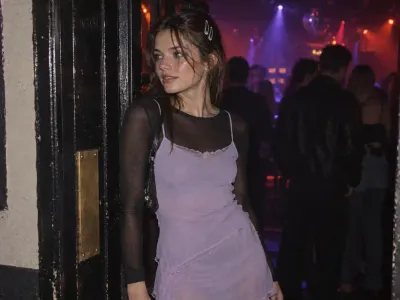
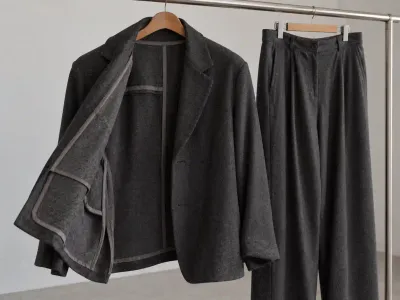
The 1990s throughout the 1990s
Helmut Lang
The Viennese designer of the decade's hardest-edged minimalism - elastic, slashed elbows, vinyl and technical cloth - who showed in Paris from 1986, moved to New York in 1998 and was the first to put a collection online.
If someone asked me what "modern" meant in 1990s fashion, I'd show them Helmut Lang. He belongs with Calvin Klein and Jil Sander among the decade's minimalists, but as the Museum at FIT puts it, even his simplest work "featured idiosyncratic details". There was elastic where you expected a seam, a slit where you expected an elbow, and cloth borrowed from places fashion didn't usually shop.
He came from Vienna, where he was born in 1956. According to Contemporary Fashion he set up his own studio there in 1977 and a made-to-measure shop in 1979, then worked up ready-to-wear in the mid-1980s. He first showed womenswear in Paris in 1986 and menswear in 1987; from 1993 he also taught the fashion masterclass at Vienna's University of Applied Arts. The same source describes the early collections as mixing luxury fabrics with "post-punk synthetics": shiny PVC, clingy net, silk backed with nylon, and a hot red stretch synthetic in 1992. FIT has something stranger still from spring/summer 1991, a short chemise of white paper printed with black abstract marks, with cap sleeves and a wide scoop neck - a quarter-century after the paper dress craze, and with none of its pop-art jollity.
His best-known detail arrived in 1995, when he began cutting the elbows of sleeves open. Harper's Bazaar soon named them one of fashion's most influential trends, and FIT, which calls them "status slashes", points out that they had a job to do: Lang liked high armholes and tight sleeves, and the slit gave back the movement that the fit took away. FIT's autumn 1996 sweater dress shows the idea on the plainest possible garment - a calf-length shift in a fine black and olive knit patterned with vines and flowers, with a curved drop-waist seam and long sleeves pieced with a slit at the elbow. As a dressmaker I'd call it a pressure valve. A narrow sleeve set into a high armhole looks wonderful and locks the arm; leave a short length of a sleeve seam open at the bend and the problem goes away.
Elastic was his other tool. Vogue's account of the autumn 1997 show, held in Paris on 13 March 1997, describes cummerbunds turned into daywear, harnesses, and bands running round the waist and one arm, so that the elastic and draping produced "slippery, imperfect fits" with "a gentle awkwardness that felt particularly human". Kirsten Owen opened in a nubby ivory car coat, and bits of floating tulle caught the air - "angel wings", one reviewer of the day called them. Alongside that softness came the technical fabrics and the 1998 "bulletproof" vest covered in the Prada nylon entry.
Then he changed how a collection reached people. In 1998 he moved his company from Europe to New York, and instead of a live show for autumn 1998 he sent clients and press a CD-ROM of the collection and put the footage on his website. FIT's black dress from that season, vinyl-coated satin that looks like leather, a scoop-necked asymmetric shift draped into a folded band at the left hip, was among the first clothes people saw on a screen rather than a runway. "I sensed at the time that the Internet would grow into something much bigger than imaginable," he told Vogue years later. A season later he moved his live show from Paris to New York, and Vogue credits him as the reason the fashion season now opens in the United States rather than in Europe. Accounts of the 1998 schedule differ in their details.
In 1999 he sold a 51 per cent stake in the company to Prada. He later left fashion to work as an artist, but the clothes still read as current. Contemporary Fashion sums up his approach as "a nonreferential view of fashion", and it shows: no period costume, no nostalgia, only cloth, cut and the body inside them.
Sources
- "Lang, Helmut" - Contemporary Fashion, via Encyclopedia.com
- Dress, paper, Helmut Lang, spring/summer 1991 (91.24.1) - The Museum at FIT
- Ensemble, Helmut Lang, fall 2003 (2009.32.17), with note on the 'status slashes' of 1995 - The Museum at FIT
- Dress, wool knit, Helmut Lang, fall 1996 (2003.90.4) - The Museum at FIT
- Helmut Lang, Fall 1997 Ready-to-Wear - Vogue Runway
- Helmut Lang, Fall 1998 Ready-to-Wear - Vogue Runway
- Dress, vinyl-coated satin, Helmut Lang, fall/winter 1998 (98.95.1) - The Museum at FIT