The 1990s throughout the 1990s
Unstructured Tailoring
Jackets without big shoulder pads, stiff canvas or full linings - soft, light, fluid tailoring that followed the body instead of building a new one, and replaced the 1980s power suit.
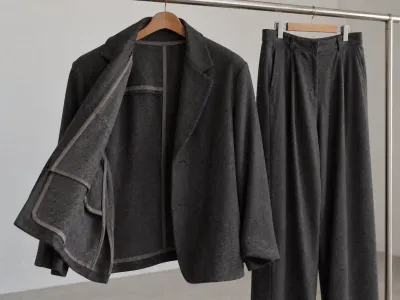
The 1980s power silhouette depended on heavily built jackets: large shoulder pads, firm interlinings, and structured shapes that gave the wearer a strong, broad outline. The 1990s took all of that away. The typical jacket of the decade was soft, light, and unstructured, and I think it's one of the most important construction changes of the late twentieth century.
To understand what changed, it helps to know how a traditional tailored jacket is built. Inside, it has layers most people never see: a canvas interlining shaping the chest and lapels, padding at the shoulders, often a roll of wadding at the top of the sleeve, stiffened collars, and a full lining. All of these give the jacket its shape, independent of the body. An unstructured jacket leaves most of them out. It might have only light fusible interfacing, or none at all; the shoulder pads are thin or gone; the lining may be partial or absent; and seams might be neatly finished and left exposed inside. The result is a jacket that drapes and moves with the body, closer to a cardigan or shirt in feel.
The roots go back to the 1970s and 1980s, when the Italian designer Giorgio Armani became famous for softening men's and women's tailoring. But in the 1990s, the idea went further. Minimalist designers like Jil Sander and Helmut Lang made jackets that were lean, simple, and light, often in fine wools, stretch fabrics, or technical materials. Miuccia Prada used soft, slightly odd proportions, and Martin Margiela even exposed or removed the inner structure of jackets on purpose.
There's an interesting counterpoint in Alexander McQueen, whose Savile Row training gave him mastery of traditional structured tailoring, which he used for sharp, dramatic shapes. The decade had room for both.
What I find most meaningful about unstructured tailoring is what it said about women at work. The 1980s power suit borrowed authority from men's clothing through structure and bulk. The 1990s suggested authority didn't need armour - a woman could look competent in something soft, light, and comfortable. For sewists, unstructured jackets are also much more approachable than traditional tailoring, which is part of why so many modern jacket patterns follow the 1990s approach.