The 1990s throughout the 1990s
PVC and Vinyl Clubwear
Wet-look PVC, vinyl and latex moved from London's fetish clubs onto the catwalks of Versace, Mugler and Gaultier, into pop videos and, by the end of the decade, into teenage girls' trousers on the high street.
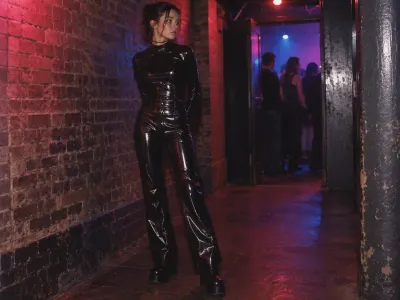
In the 1960s PVC was the fabric of the future, stiff and shiny and worn in daylight. In the 1990s it went out at night. The route ran through Vivienne Westwood's King's Road shop, which sold rubber, PVC and fetish wear in 1974, and the cloth itself had changed. The New Zealand Fashion Museum notes that in the 1990s mills developed "new stretch wet look fabrics using PVC bonded to knitted fabrics." A 1960s raincoat stood away from the body. The new stuff clung like a leotard.
London's fetish clubs wore it hardest. Skin Two, the magazine founded in 1983 by the publisher Tim Woodward and the photographer Grace Lau, covered latex and fetish clothing, and its annual Rubber Ball became the centre of a London weekend of parties. Torture Garden opened in October 1990, started by two flatmates, Allen Pelling and David Wood. About a hundred people came to the first Thursday night, in a pub in Shepherd's Bush, and about five hundred by the fourth or fifth. In the early 1990s police orders closed venues and cancelled nights. What mattered for fashion was the door. "If it won't turn heads in the street - don't bother," ran the policy, so the clothes were the price of entry. Wood remembers the early 1990s as "a very innovative time for fetish fashion," and designers came to look: i-D lists Alexander McQueen and Jean Paul Gaultier among the guests. Pelling's claim that Gaultier "took a load of ideas and started a collection" is his own.
Small London makers were already working in rubber. The V&A bought a pair of women's latex hot pants by Danielle Oppegaard in 1992, the year they were made: the rubber came from 4D in Derbyshire, Modern Armour in Letchworth made them up, and they close with a metal zip. That same year Versace showed his bondage collection. Thierry Mugler's spring 1992 show, Les Cowboys, had a motorcycle bustier of plastic, metal and Plexiglas, with rear-view mirrors at the shoulders, held on by leather straps and buckles; he directed George Michael's "Too Funky" video the same year and put the bustier in it. Gaultier's contribution in the V&A is a pair of black PVC gauntlets from 1996 fastened with brass buttons and buckles. In London, Owen Gaster's spring/summer 1997 "Clockwork Dragonz" collection included a black skirt suit in thermochromic PVC, which changes colour where it touches warmth, lined in green polyester. For autumn 1998 Helmut Lang made a dress of vinyl-coated satin.
Pop carried it to a younger audience. In the 1996 video for the Spice Girls' "Say You'll Be There," Victoria Adams wore a latex catsuit. By 1997 the high street had made it for teenagers: the Museum of Design in Plastics has a pair of "Attitude" trousers from Tammy, a range for teenage girls, in a PVC coating that imitates leather on a 65/35 polyester-cotton knit, lined in nylon down to the knee. Shiny trousers like these lasted into the Y2K wardrobe.
Sewing PVC punishes mistakes. Bernina's tip sheet for its non-stick feet sums it up: hold edges with clips, tape or glue stick, never pins, "because once holes are made, they will always be there." A metal presser foot drags on the shiny side, so you use a foot with a non-stick sole, or put tissue paper on top and tear it away afterwards. Don't use a leather needle, whose wedge point cuts the plastic. Use an ordinary needle and a long stitch, 4 to 5 millimetres, so the holes don't line up into a tear. Keep the iron away, because heat glazes or melts the coating. Finger-press the seams open and topstitch or glue the allowances down instead. That knee-deep lining in the Tammy trousers is a good touch: plastic against bare skin is clammy, and a slippery nylon lining lets the trousers slide on.
Sources
- Black PVC T-shirt, Feline (Tanya Sheridan and Andrew Bishop), Auckland, 1996 - New Zealand Fashion Museum
- Skin Two Rubber Ball Archive - Bishopsgate Institute
- Helen Meriel Thomas, "Inside 'Torture Garden', the World's Most Famous Fetish Club" - Vice, 17 November 2022
- "Lessons learnt from London's biggest fetish club" - i-D, 17 November 2015
- Women's hot pants, latex, Danielle Oppegaard, rubber by 4D, made by Modern Armour, 1992 (T.292-1992) - V&A Collections
- Lane Markulics, "1992 - Thierry Mugler, Bustier" - Fashion History Timeline, Fashion Institute of Technology
- Pair of gauntlets, black PVC with brass buttons, Jean Paul Gaultier, 1996 (T.97:1, 2-2011) - V&A Collections
- Skirt suit, thermochromic PVC, 'Clockwork Dragonz', Owen Gaster, spring/summer 1997 (T.23:1, 2-1997) - V&A Collections
- Frankie Dunn, "9 of the Spice Girls' most iconic fashion moments" - i-D, 3 November 2021
- Tammy Attitude trousers, PVC-coated knit, 1997 (AIBDC : 0_2723) - Museum of Design in Plastics (MoDiP)
- Susan Beck, "Non-Stick Open Embroidery Foot #56: Tips for Sewing Leather, Plastic & Vinyl" - BERNINA of America, 2014